Every closet door and drawer gets opened thousands of times a year. The hinge, the runner, and the finish decide whether that motion stays silent for twenty years or announces itself within two.
Short answer: closet hardware is rated for a number of open-close cycles, and that number — not the finish, not the brand name on the box — is what separates hardware that lasts decades from hardware that fails within a few years. Look for concealed hinges rated at 80,000+ cycles, full-extension ball-bearing runners rated at 80,000–100,000+ cycles for daily-use drawers, and soft-close mechanisms built into the hinge or runner itself rather than added as a separate clip-on damper. Everything else — brass or matte black, knob or lever — is a legitimate style decision. Cycle rating is not.
We have mentioned hardware in passing throughout our other guides — the drawer runners in our cost guide, the operable-parts standard in our accessible design guide — because it keeps being the detail that actually determines how a closet ages. This is the dedicated version: what the numbers mean, what to ask for, and where the honest tradeoffs sit.
Why Cycle Rating Is the Number That Matters
A cycle is one full open-and-close. A primary closet door or drawer used daily sees somewhere around 1,000 to 1,500 cycles a year — which sounds modest until you multiply it by a house you intend to live in for decades. Hardware manufacturers test to third-party cycle standards, most commonly ANSI/BHMA A156.9 for cabinet hardware in North America, and publish a rated cycle life as a result. The gap between grades is not marginal: a builder-grade hinge and a professional-grade European hinge can differ by a factor of ten.
| Tier | Hinge cycle rating | Runner cycle rating | Soft-close |
|---|---|---|---|
| Builder-grade | ~25,000–35,000 | ~25,000–40,000 | Often absent or clip-on |
| Mid-grade | ~50,000–80,000 | ~50,000–80,000 | Integrated, single-speed |
| Professional-grade (European) | 80,000–200,000+ | 80,000–100,000+ | Integrated, tuned damping |
Rated cycle life by hardware tier
Hinges: The Small Part Carrying the Whole Door
Concealed cup hinges — the round cup seated in a drilled recess, invisible when the door is closed — are the standard for cabinet doors, and the differences between grades show up in three places: the cycle rating, the opening angle (110° is standard; 165°+ opens flush against an adjacent panel, useful at corners), and three-way adjustability, which lets a door be fine-tuned up-down, left-right, and in-out after installation so every gap in a run stays even as the house settles. A hinge without that adjustment range is fixed at whatever alignment the day of installation gave it — and a house is never perfectly static.
Drawer Runners: Where Weight Actually Lives
A drawer carries far more load than a door ever does, which is why runner quality matters even more. Full-extension, ball-bearing runners let a drawer pull out completely, so the back is as usable as the front — a detail we specify as standard, since a drawer you can't fully open is a drawer that quietly loses a third of its capacity. Undermount concealed runners (mounted beneath the drawer box rather than on its sides) hide the mechanism entirely and usually integrate the soft-close damper into the same unit, at the cost of slightly reduced drawer width versus side-mount runners. Load rating matters by content: a shoe or sweater drawer wants a runner rated for at least 100 lbs; a jewelry drawer's actual load is trivial, and the runner grade there is about smoothness and longevity rather than capacity.
Soft-Close, Explained
Soft-close uses a small hydraulic or pneumatic damper to decelerate a door or drawer in the last few inches of travel, so it settles rather than slams. The better mechanisms are integrated directly into the hinge or runner body and tuned for that specific piece of hardware's weight; the worse ones are a generic clip-on damper added after the fact, which wears out faster and is rarely rated for the same cycle life as the hardware it's attached to. Touch-latch or push-to-open hardware takes this a step further and removes the need for a handle altogether — relevant not just for a minimal, handleless aesthetic but for accessibility, since it requires no grasp at all, a point we cover in more detail in our accessible design guide.
Finish: Brass, Matte Black, Nickel, and What Actually Wears
Finish is a style decision layered on top of the mechanical one, but not every finish wears the same way. PVD (physical vapor deposition) coatings bond at a molecular level and resist fingerprints, scratching, and tarnish far better than a plated finish, which is a thinner surface layer that can wear through at high-touch points over years of use. This matters more in our coastal commissions than most homeowners expect: Newport Beach and Laguna Beach marine air is mildly corrosive to lower-grade plated hardware over a decade, the same climate argument we make for panel cores and finishes in our materials guide. Matte black has become the most requested finish in recent years for its fingerprint resistance and contemporary read; brass and warm bronze tones are the classic pairing with European oak; brushed nickel sits neutrally between the two. All three are available in durable PVD finishes — the color is the design decision, the coating quality is the durability decision, and the two should never be confused.
Visible Hardware vs. Handleless
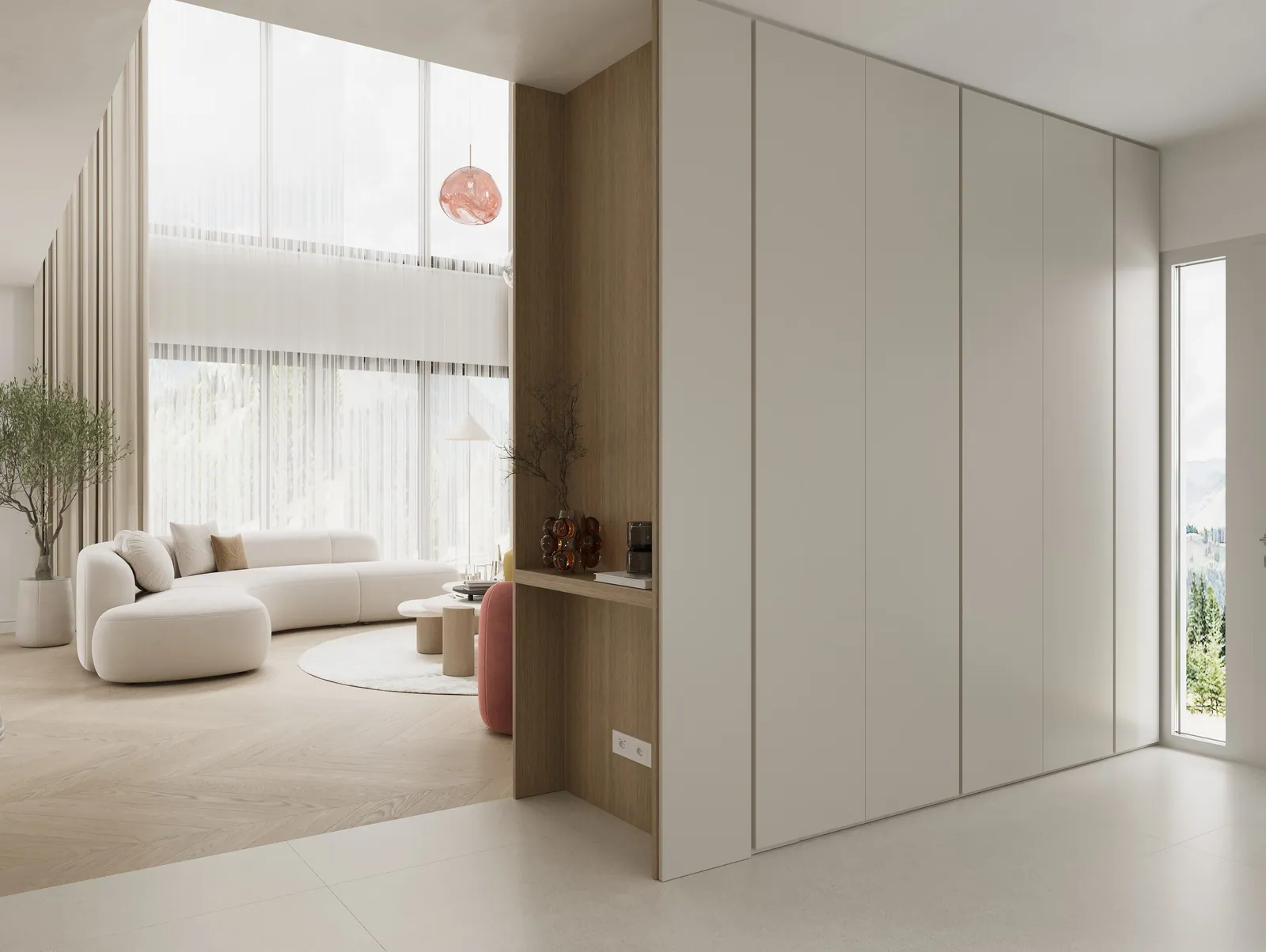
The choice between visible pulls and a handleless, touch-latch system is largely aesthetic, but each comes with a real tradeoff. Visible pulls are more forgiving to operate one-handed and give a room a more traditional, tactile character; handleless doors read as pure architecture — the same continuous-surface argument we made in our cabinetry and millwork guide — but ask more of the touch-latch mechanism's reliability, since there's no manual backup if the latch ever fails to release. We spec touch-latch systems only from manufacturers whose mechanisms carry the same cycle-rating rigor as their hinges, for exactly this reason.
What This Costs
Hardware is a small line item relative to the millwork it's attached to, but the gap between grades is proportionally larger than almost anything else on a quote — a professional-grade European hinge can cost several times a builder-grade equivalent, and a full closet's worth of upgraded hinges and runners is still a modest fraction of total project cost. Our honest cost guide lists hardware among the categories worth spending on rather than cutting, precisely because it's the part physically touched the most and replaced the least easily once a cabinet is finished.
Frequently Asked Questions
What cycle rating should I ask for on closet hardware?
At minimum 50,000 cycles for daily-use doors and drawers; 80,000 to 100,000+ is the professional-grade range we specify as standard, and it's worth asking any bidder to state the number rather than just the brand name.
Is soft-close hardware worth the upgrade?
Yes, and it's one of the least expensive upgrades relative to its daily impact — a slammed drawer wears its runners faster than a damped one, so soft-close hardware often outlasts standard hardware even before counting the noise and feel.
Do handleless, touch-latch doors fail more often than doors with pulls?
Not when the touch-latch mechanism is specified to the same cycle-rating standard as the hinge it's paired with. The risk is real with lower-grade touch-latch hardware, which is why we source it only from manufacturers who rate it as rigorously as their hinges.
Can hardware be upgraded on an existing closet without rebuilding it?
Often, yes, if the cabinet boxes themselves are sound — hinges and runners can frequently be swapped for higher-grade equivalents. It's one of the more cost-effective ways to extend the useful life of an otherwise decent existing system.
Want hardware that disappears into daily use instead of announcing its age? Begin with a private in-home consultation across Newport Beach, Laguna Beach, Irvine, and Palm Springs. Request a design consultation or call (949) 200-6778.