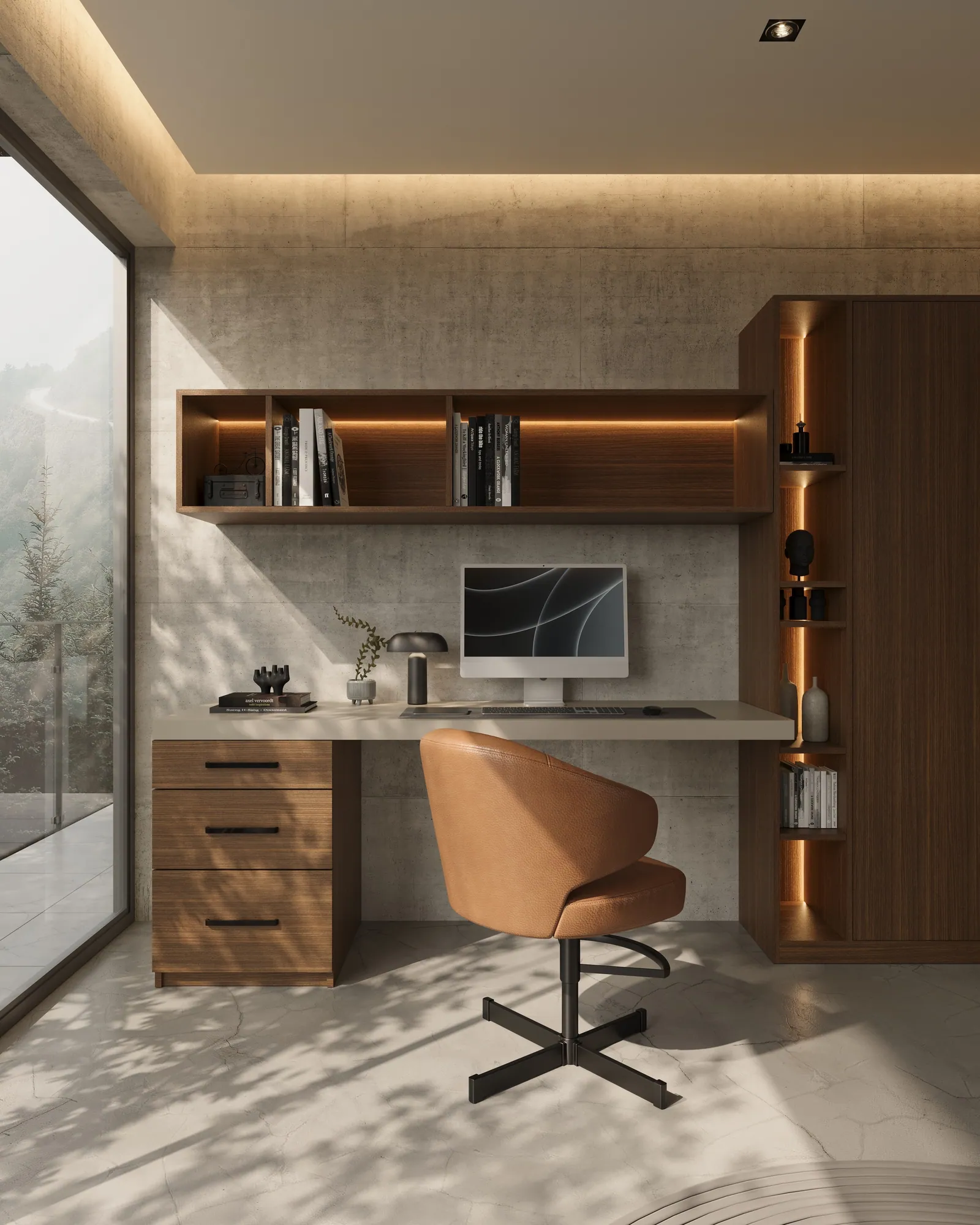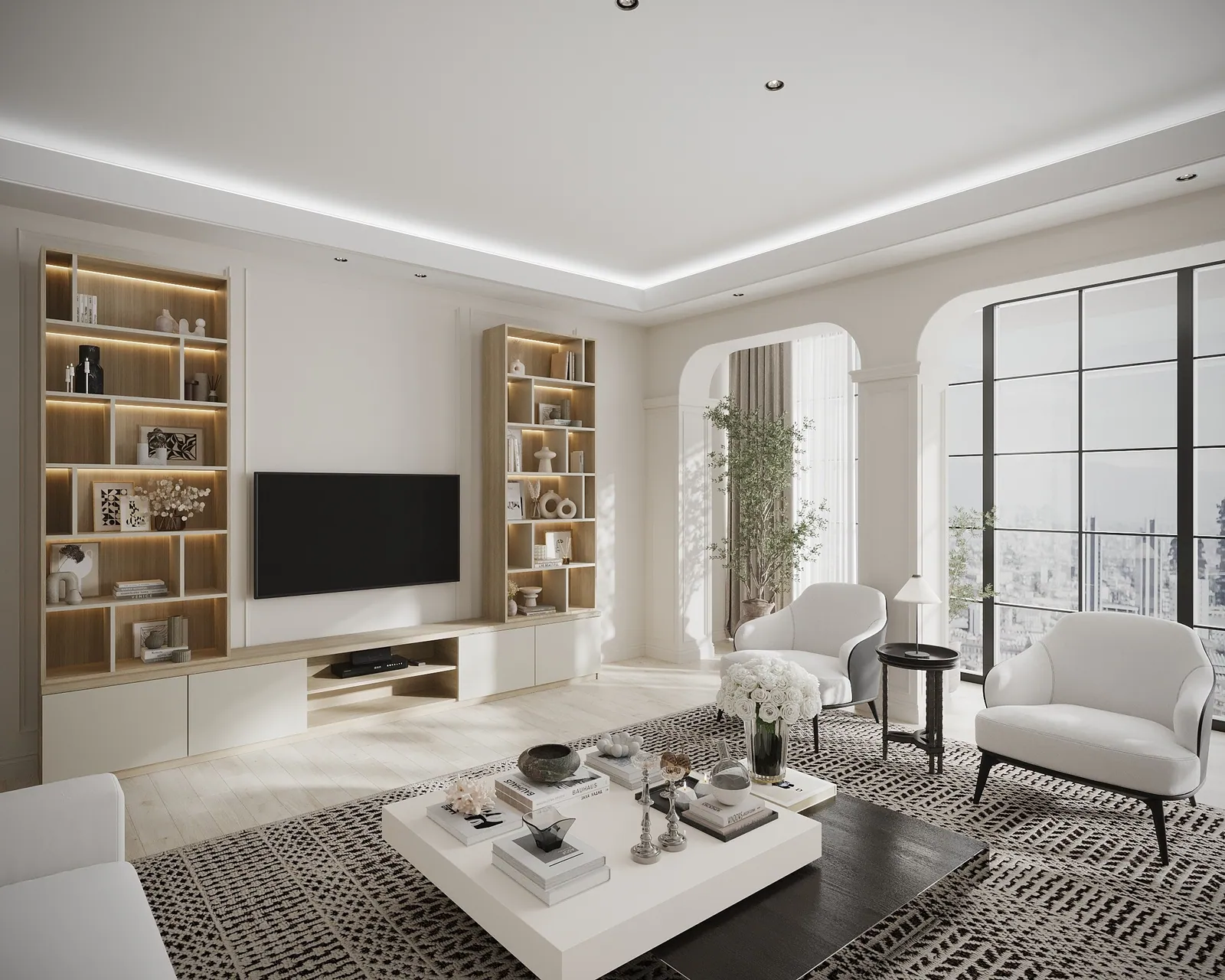
Cabinetry, millwork, furniture — the words get used interchangeably, but the distinction determines fit, permanence, and resale value. Where each belongs in a home, and where millwork shows up beyond the closet.
Short answer: millwork is any wood element built into a room's architecture on-site and finished to match it — cabinetry, paneling, trim. Cabinetry is the subset of millwork built as cabinets: doors, drawers, shelving. Furniture is unattached and portable. The dividing line is simple: if it leaves the house when you move, it's furniture; if it was built for that wall and that wall only, it's millwork. Custom cabinetry sits in between — attached and built-to-order, but composed of cabinet modules rather than continuous integrated surfaces.
These three words get used interchangeably in showrooms and listings, and the confusion is not harmless — it is usually the reason a homeowner budgets for one thing and receives another. We have described the closet-specific version of this argument in The Anatomy of a Custom Closet and the material science behind it in our materials and finishes guide. This piece is about the broader category: what actually separates millwork from cabinetry from furniture, and where built-in millwork earns its place in a home beyond the closet.
Millwork, Cabinetry, and Furniture — What Actually Separates Them
The categories differ on four practical axes: whether a piece is fixed to the building, how tightly it fits its exact space, what happens to it at resale, and how it is priced.
| Furniture | Custom cabinetry | Architectural millwork | |
|---|---|---|---|
| Attachment | Freestanding, unattached | Fixed to the wall, modular units | Built into the structure, continuous |
| Fit tolerance | Generic dimensions | Built-to-order, scribed to fit | Measured and cut for one specific wall |
| Moves with you? | Yes | Sometimes, with effort | No — it stays with the house |
| Effect on resale | None; excluded from sale | Adds to the home's fixtures | Adds to appraised architectural value |
| Typical examples | A dresser, a bookcase, a sideboard | A closet system, a kitchen run | A media wall, library paneling, a window seat |
The permanence spectrum — furniture to millwork
Where Millwork Shows Up Beyond the Closet
Closets and pantries are where most homeowners first encounter custom cabinetry, but architectural millwork's natural territory is wider. These are the rooms and walls where we see it do the most work.
Media & Entertainment Walls
A television mounted on drywall with cables run along the baseboard is furniture-grade thinking applied to an architectural wall. Millwork solves it properly: a full-height cabinet run with a recessed niche sized to the exact screen, concealed ventilation for the components behind closed doors, and cable pathways built into the carcass before the wall is ever closed up. The screen becomes one detail in a composed wall rather than the wall's entire reason for existing.
Home Libraries & Bookcases
A stock bookcase stops short of the ceiling and sits proud of the wall, announcing itself as an object placed in the room. Built-in library millwork does the opposite — it runs floor to ceiling, wraps into corners, and steps around windows and doorways as though the room were designed around the books rather than the shelf being squeezed in afterward. Adjustable shelf-pin spacing, the same principle described in our children's closet guide, keeps it useful as a collection grows or changes.
Wet Bars & Wine Storage
A wet bar is one of the few pieces of millwork that has to solve a plumbing and refrigeration problem as well as a storage one. Built-in cabinetry integrates the under-counter fridge, the ice maker, and the sink into a single continuous run with a stone or wood top, rather than leaving a gap in the cabinetry where an appliance was wedged in later.
Window Seats & Banquettes
A window seat only works as millwork — it has to be built to the exact width of the window bay, with storage underneath sized to the cushion above it. This is one of the clearest cases where furniture simply cannot do the job: no manufactured bench will ever match an odd bay window's dimensions, and a poor fit is immediately visible in a way a slightly-too-small bookcase is not.
Wainscoting & Paneling
Paneling is millwork with no cabinetry component at all — pure architecture, applied to a wall to add proportion, rhythm, and a sense of permanence a painted drywall wall cannot offer on its own. It is often the detail that makes an adjacent cabinetry run — a fireplace built-in, an entryway bench — read as part of the house rather than an addition to it.
Why Built-In Beats Stock, Beyond Aesthetics
The visual case for millwork is obvious in a showroom. The less obvious case is economic. Furniture depreciates the moment it leaves the store and is explicitly excluded from a home sale. Architectural millwork, by contrast, is a fixture — legally and practically part of the structure — and well-executed built-ins are routinely cited by appraisers and agents as features that support a home's value, the same way a renovated kitchen does. The honest cost guide we wrote for closets applies the identical logic here: the premium over stock cabinetry buys a fit and a permanence that a future owner is buying too, not just the current one.
How Millwork Actually Gets Built
The process is closer to architecture than to furniture shopping, and it follows the same phases described in our design-to-installation timeline guide: an in-home consultation to measure the actual wall (not a nominal one), shop drawings engineered to that wall's true dimensions, fabrication in our own shop, and on-site installation with final scribing to the ceiling, floor, and adjoining walls. That last step — scribing — is what a factory-built piece can never do: a finished edge cut and fitted on-site to a wall that is never perfectly flat or perfectly square, so the seam disappears instead of announcing itself with a gap.
Frequently Asked Questions
Is built-in cabinetry the same as millwork?
Not quite — cabinetry is a category within millwork, specifically the parts built as cabinets with doors, drawers, or shelving. Millwork also includes paneling, trim, and window seats that have no cabinet component at all.
Does custom cabinetry actually add to a home's resale value?
Generally yes, when it's well executed and reads as architecture rather than an obvious add-on. Because it's fixed to the structure, it's treated as a fixture at sale, unlike furniture, which the seller typically takes with them.
Can furniture and millwork be mixed in the same room?
Almost every room should mix them. A library might have built-in shelving millwork with a freestanding reading chair; a media wall might be millwork with a furniture-grade console left empty in front of it for flexibility. The skill is deciding which specific elements deserve permanence and which benefit from staying movable.
How is millwork priced compared to stock cabinetry?
Millwork is typically priced by the linear foot of custom design and fabrication rather than by unit, since no two runs are identical. Our cost guide breaks down the same material and complexity tiers that apply here.
Have a wall, a library, or a media room that deserves architecture instead of furniture? Begin with a private in-home consultation across Newport Beach, Laguna Beach, Irvine, and Palm Springs. Request a design consultation or call (949) 200-6778.