Quotes for the same room can differ by a factor of ten. Here is why — real 2026 ranges, what actually drives cost, and where money is well spent.
Ask three companies to quote the same closet and you may receive numbers that differ by a factor of ten. None of them is necessarily lying. They are quoting three different things — and until you know which is which, every number is noise.
We have designed and built architectural storage since 1969, and we would rather publish an honest map of the market than a teaser price. What follows are realistic 2026 ranges for the United States, what actually moves the number, and — more useful than either — where money is well spent and where it quietly evaporates.
The Short Answer: Typical Ranges in 2026
Broad strokes, for a typical primary-bedroom project:
- Wire and laminate kit systems (big-box, self-installed): roughly $500–$2,500 per closet. Functional, temporary in feel, and priced accordingly.
- Modular closet systems (franchise dealers, standard components): about $2,500–$8,000 for a reach-in, $5,000–$15,000 for a walk-in, installed.
- Semi-custom systems (local shops, upgraded finishes, some site tailoring): typically $15,000–$40,000 for a full walk-in.
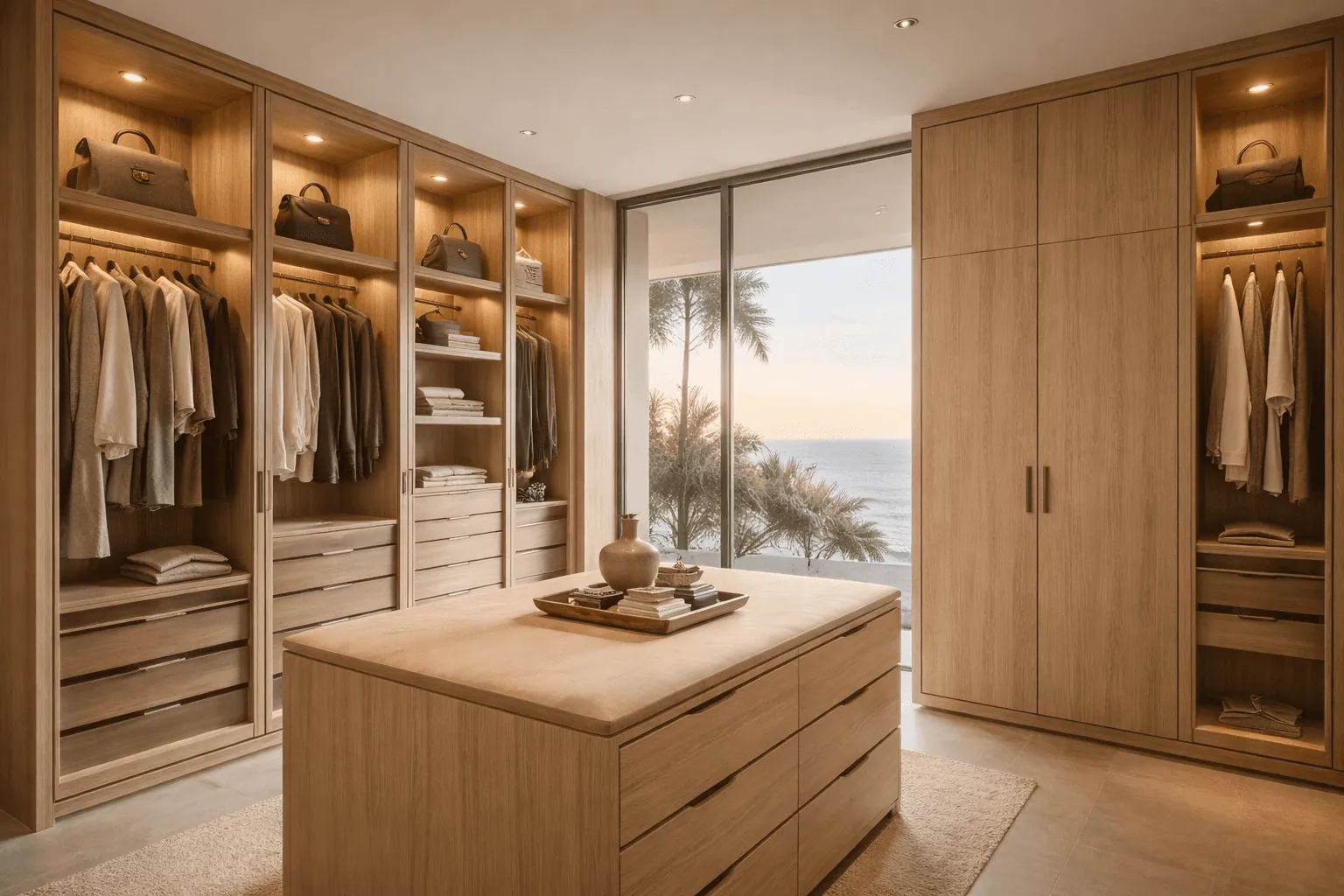
- Bespoke architectural millwork (designed for one room, built to furniture tolerances, fully integrated): generally $40,000–$150,000+ for a primary dressing room, depending on scale and materials. Islands alone commonly run $5,000–$25,000.
Per linear foot — a unit the industry loves and misuses — expect roughly $125–$300 for modular systems, $300–$600 for semi-custom, and $1,000 and up for true architectural millwork. Treat all such figures as orientation, not gospel: a linear foot of melamine and a linear foot of European oak with integrated lighting are not the same product wearing different prices. They are different products.
What Actually Drives the Cost
Five variables explain nearly every quote you will receive.
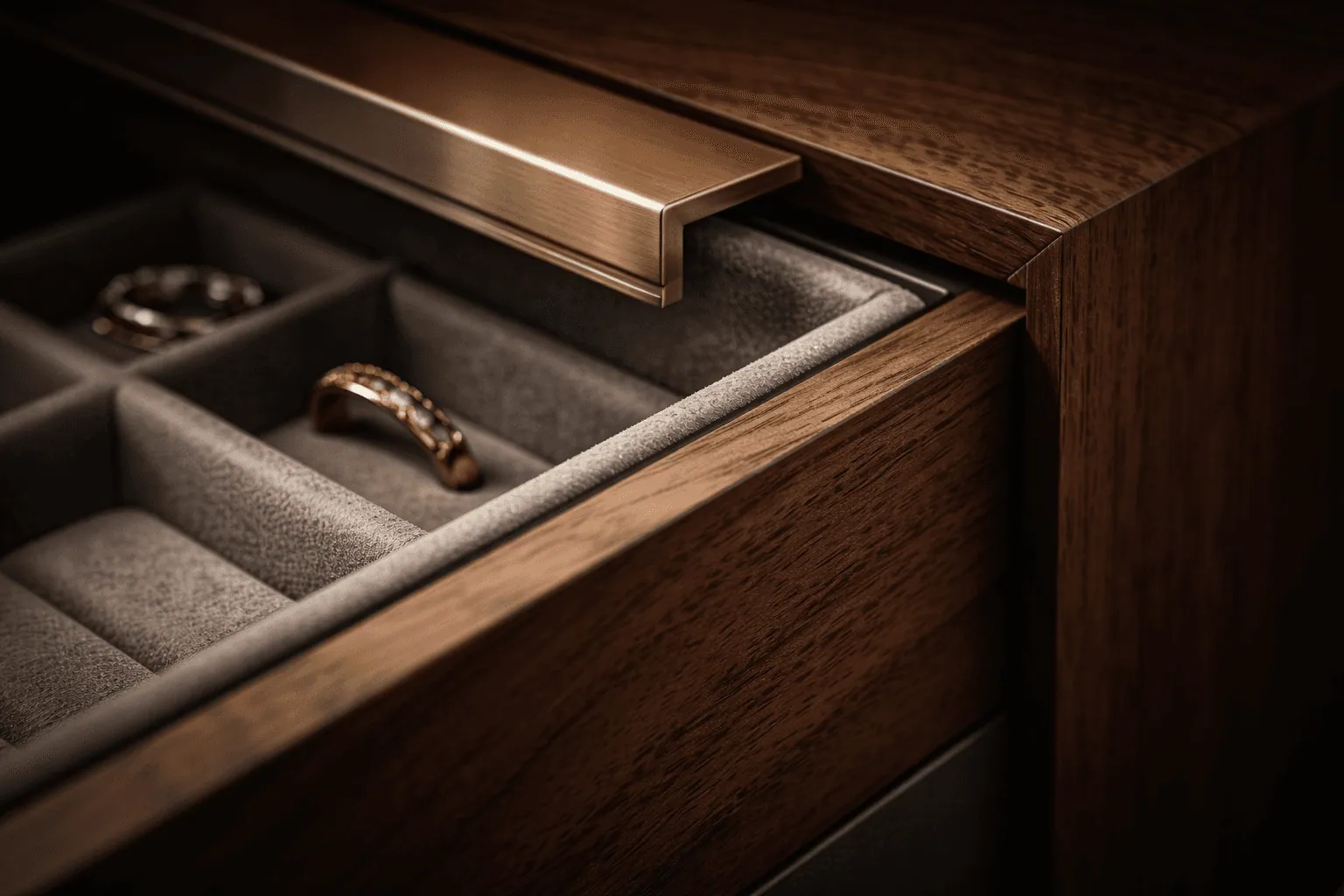
Construction. How panels are joined is invisible and decisive. Cam locks and screws are fast and cheap; dowelled, pressed joinery costs more and lasts decades longer. This single choice separates furniture from product — the argument we made in The Anatomy of a Custom Closet.
Materials. Melamine, thermally fused laminate, wood veneer, and solid or engineered European oak form an honest ladder, each rung roughly doubling the material cost of the last. Hardware follows the same ladder: drawer runners rated for 25,000 cycles and runners rated for 250,000 do not cost the same, and you feel the difference every morning.
Integration. A system that stops short of the ceiling is cheaper than millwork scribed to the ceiling plane, absorbed baseboards, and reveals aligned with the room's datum lines. Integration is carpentry's equivalent of tailoring — most of the cost is in what you don't see.
Lighting. Integrated LED — channels routed before finishing, warm, dimmable, true-color — typically adds $2,000–$10,000 to a walk-in and transforms it more than any single material upgrade. Clip-on lighting is cheaper and looks it.
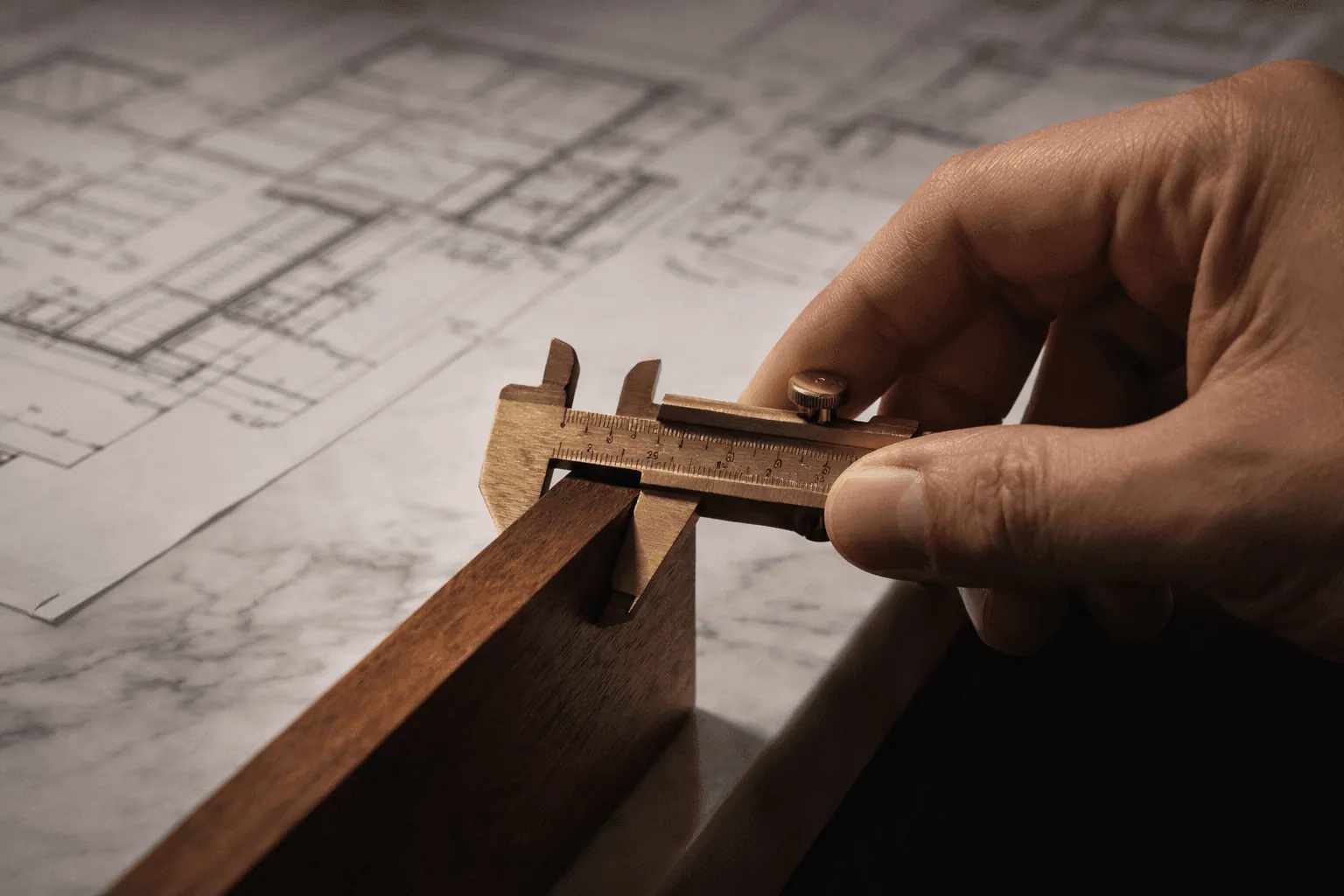
Who designs it. Software configuration from measurements is free and worth it. Design by someone who has stood in the room — plans, elevations, materials, revisions — is a professional service embedded in the price, as we described in Custom Walk-In Closets: Composing a Room.
Why Quotes for the Same Room Differ So Wildly
Because "custom closet" is not one product. A franchise dealer, a local shop, and a design-build atelier will all say the word "custom" and mean three different trades. The dealer configures a catalog; the shop adapts a standard system; the atelier designs and builds architecture for one room only. Comparing their quotes line-by-line is comparing a suit off the rack, made-to-measure, and full bespoke — related garments, different work.
The practical advice: before comparing numbers, compare edges. Ask each bidder how panels meet the ceiling, what happens at the baseboard, where the piece is built, and who returns if a drawer whispers a year later. The answers sort the quotes into their true categories faster than any spreadsheet.
Where Money Is Well Spent — and Where It Evaporates
Well spent: joinery and hardware (the parts touched ten thousand times a year), full-height integration (the difference between architecture and furniture), integrated lighting (the single most transformative line on the quote), and design time (an hour of good design saves thousands in built regret).
Evaporates: motorized gadgetry that fails before the finish fades, imitation finishes photographed to look like wood, capacity for a wardrobe you do not own, and showroom spectacle — mirrored islands and jewelry theaters that serve the sales floor more than the morning. Restraint, as we argued in The Principles of Luxury Closet Design, is not just an aesthetic. It is a budget strategy.
The Cost of Cheap
A $4,000 system replaced every eight to ten years is not a $4,000 system; it is a subscription. Sagging shelves, drifting doors, and lifted edge-banding arrive quietly in year five and are rarely worth repairing. Bespoke millwork built to furniture tolerances is designed to be the last closet the room ever needs — and to age like the home rather than like a purchase. Whether that arithmetic favors you depends on how long you will own the house and how much order is worth to your mornings. It is at least arithmetic worth doing.
A Note on California
Coastal and desert homes carry a specification premium worth paying. Marine air in Newport Beach and Laguna Beach asks for sealed, balanced panels and corrosion-considered hardware; Palm Springs sun demands UV-inhibiting finishes and dimensionally stable cores. These line items are invisible on installation day and unmistakable a decade later — the cheapest place to save money is never the climate spec.
How Vallier Prices a Commission
We do not price from a list, because we do not build from one. Every commission begins with a private in-home consultation across Newport Beach, Laguna Beach, Irvine, and Palm Springs; a tailored proposal follows, reflecting your actual room, materials, and scope — plans and elevations included, so you can see precisely what the number buys. A single room is typically delivered in about eight weeks; the timeline and the figure are confirmed at the design stage and honored.
Frequently Asked Questions
How much does a custom walk-in closet cost on average?
In 2026, installed modular walk-ins commonly run $5,000–$15,000; semi-custom work $15,000–$40,000; bespoke architectural dressing rooms generally $40,000–$150,000+ depending on scale, materials, and integration.
What is the cost per linear foot for custom closets?
Roughly $125–$300 for modular systems, $300–$600 for semi-custom, and $1,000+ for architectural millwork. Use the figure only to compare like with like — the unit hides more than it reveals.
Do custom closets add value to a home?
Well-executed storage consistently ranks among the features buyers notice, and in the refined-home market an architectural dressing room reads as part of the house's quality, not an accessory. The stronger case is daily: you live in the closet every morning; the resale argument is a bonus.
Why not just use a modular system?
For a rental, a first home, or a short horizon — do. Modular systems are honest products at honest prices. The case for bespoke begins when the home is long-term, the architecture deserves respect, and replacement cycles stop making sense.
How should I budget for a project?
Decide the tier first — kit, modular, semi-custom, or bespoke — then budget within it, reserving room for the items that repay you: joinery, hardware, integration, and lighting. A tailored proposal after an in-home consultation will always beat an internet average for your actual room.
Want a real number instead of a range? Begin with a private in-home consultation across Newport Beach, Laguna Beach, Irvine, and Palm Springs. Request a design consultation or call (949) 200-6778.