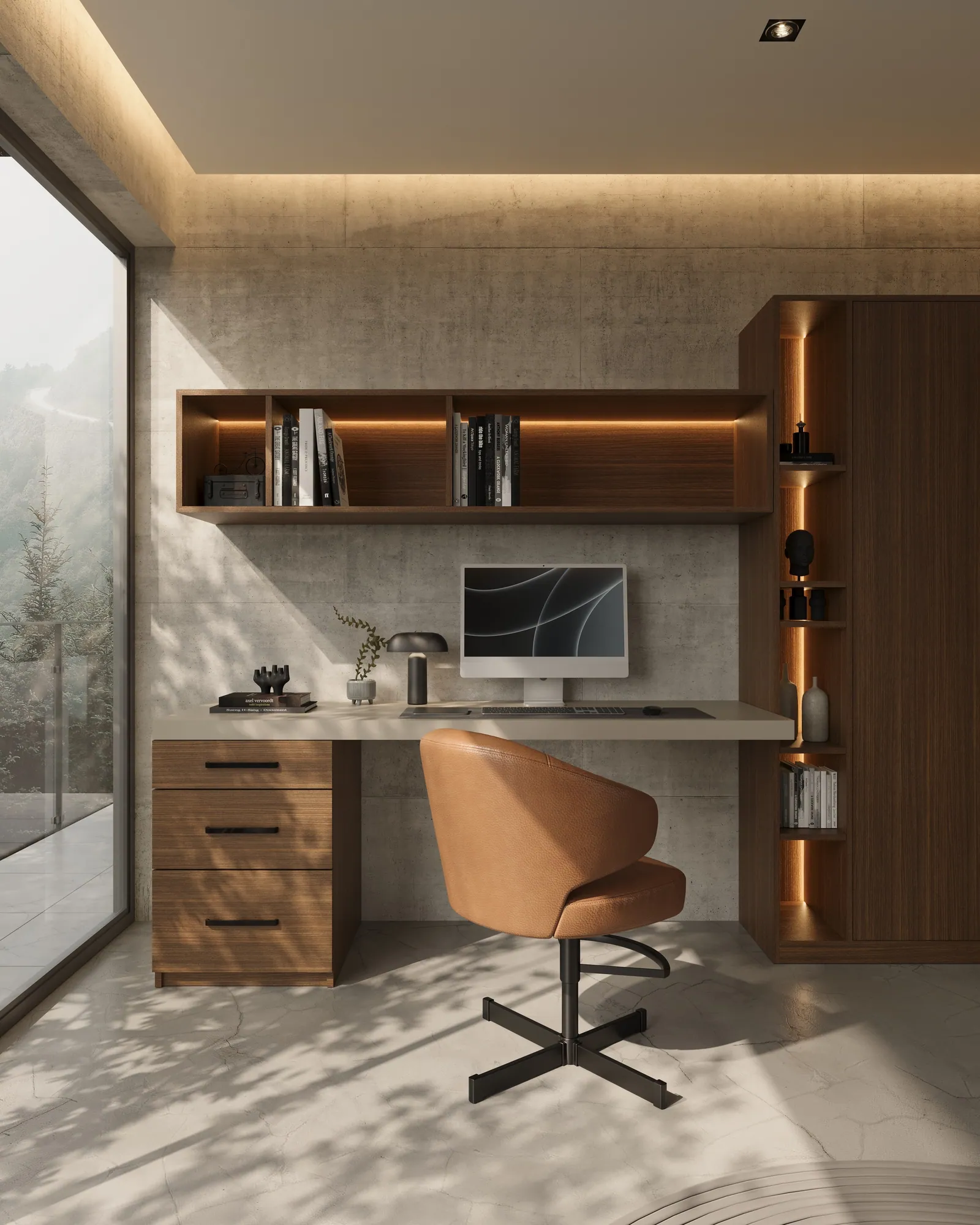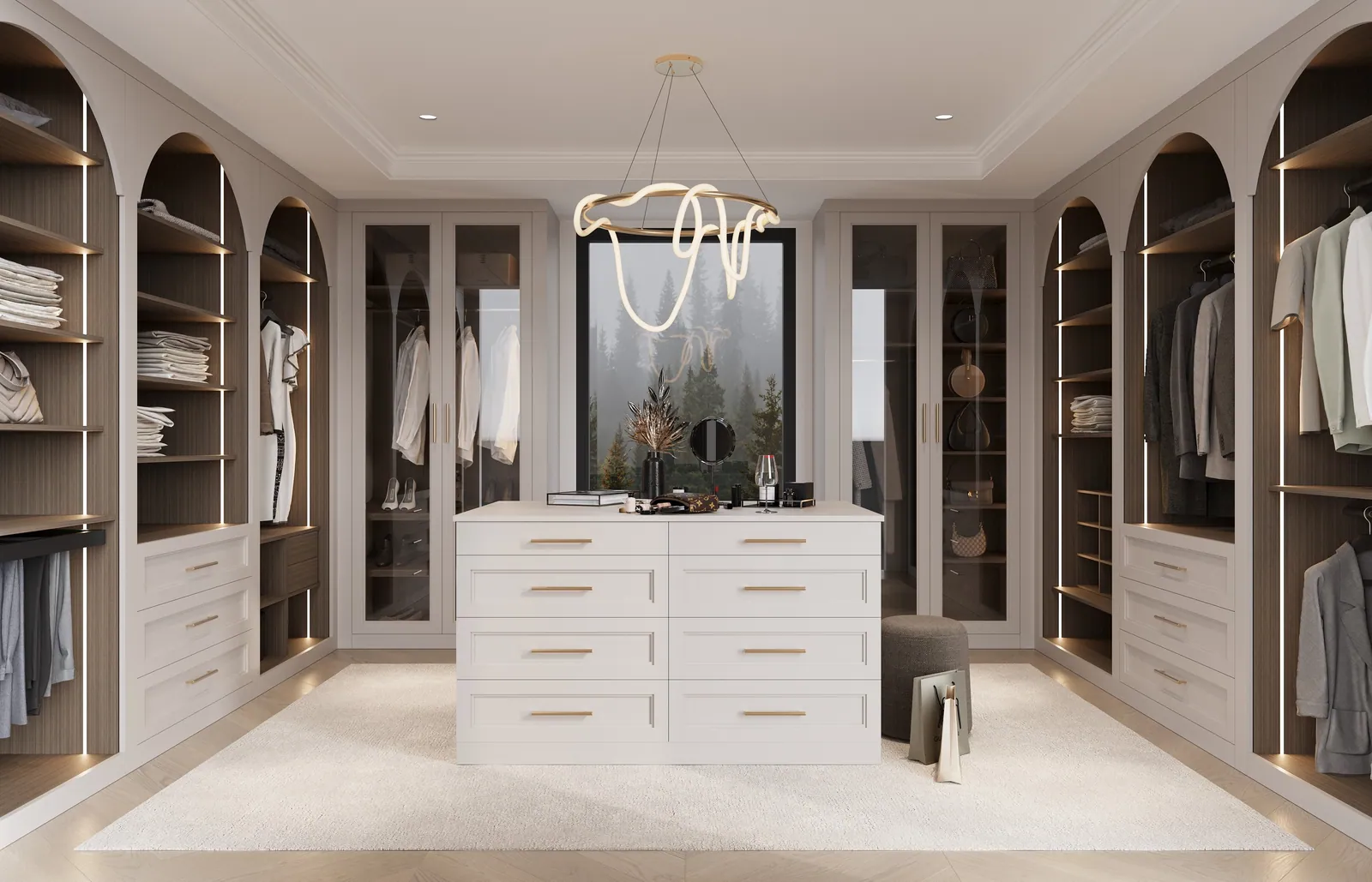
Melamine, laminate, veneer, solid oak, lacquer — the material decision drives cost, lifespan, and how a closet reads. A complete guide to choosing well.
Of every decision made in a custom closet, the choice of material is the one that most determines what the room costs, how long it lasts, and how it reads when you walk in. It sets the floor and the ceiling on quality before a single dimension is drawn. And yet it is usually the decision made last and fastest — a finish sample held up in a showroom for thirty seconds, under the wrong light, at the end of a long appointment.
This guide slows that decision down. It walks through the core beneath the surface, the four families of surface material, the wood species worth knowing, how veneer is matched, how finish and sheen behave over years of daily use, and how the whole palette should shift for a home on the California coast versus one in the desert. Our honest cost guide describes a "material ladder" where each rung roughly doubles the material cost; this is the article that explains what is actually on each rung.
The Material Ladder
Cabinet surfaces fall into four broad tiers, and the jump between each one is large — in cost, but also in how the material behaves. At the bottom is thermally fused laminate, often just called melamine: a decorative paper fused to a panel under heat and pressure. Above it, high-pressure laminate — a thicker, tougher laminate built from many layers. Above that, real wood veneer — a thin slice of actual timber bonded to a stable core. And at the top, solid or engineered European oak and other hardwoods, used where solid material genuinely performs better.
None of these is simply "good" or "bad." A serious closet uses several of them at once — solid or veneered fronts where the eye lands, a durable laminate on interiors and adjustable shelves where it never will. The skill is knowing which material each surface deserves, and being honest that roughly ninety percent of what you see in a finished closet is the door and drawer fronts.
The material ladder — relative cost and behaviour
It Starts With the Core
Every surface material is bonded to a core panel, and the core decides how flat the cabinet stays, how well it holds a screw, and how it behaves if it ever meets water. The three options are furniture-grade particleboard, medium-density fibreboard (MDF), and plywood, and the premium European tradition does not simply default to the most expensive one.
High-density furniture board is the flattest and most dimensionally stable of the three — it does not cup or move with the seasons — which is exactly what a full-height wardrobe door needs. MDF is the smoothest and machines to a crisp profile, which makes it the right substrate under a lacquer finish. Plywood is the lightest strong option and the best at shrugging off an occasional spill, but it is less flat and its face can telegraph through a thin veneer. A well-built closet uses furniture board for large flat panels, MDF under paint, and plywood where weight or moisture exposure justifies it — as described in more depth in the art of European joinery.
Whatever the core, the emissions grade matters in a room this small and often closed. Vallier specifies cores compliant with CARB Phase 2 and the federal TSCA Title VI formaldehyde limits as a floor, and to European E1 or better — with no-added-formaldehyde options available — because a closet is a space you breathe in every morning.
| Core | Flatness & stability | Screw-holding | If it meets water | Best used for |
|---|---|---|---|---|
| Furniture board | Excellent — stays flat, minimal seasonal movement | Good with proper fasteners | Swells and does not fully recover | Large flat panels, full-height doors, gables |
| MDF | Very good; heavier | Moderate — needs care at edges | Swells; edges most vulnerable | Substrate under lacquer and routed profiles |
| Plywood | Good, not perfectly flat; face can telegraph | Excellent | Handles brief exposure best of the three | Drawer boxes, wet-adjacent runs, heavy load-bearing shelves |
The Surface: Four Families
Melamine / thermally fused laminate (TFL). A decorative paper — increasingly a convincing woodgrain with a texture embossed in register with the print — fused permanently to the panel. Modern TFL is scratch- and moisture-resistant on the face, perfectly consistent from sheet to sheet, and inexpensive. Its limits are real: the edge must be banded separately, it cannot be refinished, and under close, raking light a printed grain does not have the depth of the real thing. It is an honest, excellent choice for cabinet interiors, adjustable shelves, and budget-conscious fronts.
High-pressure laminate (HPL). Built from many resin-saturated kraft layers cured under high pressure, then bonded to a core. It is markedly tougher than TFL — better against impact, abrasion, and heat — which is why it earns its place on high-wear surfaces like a dressing bench, a valet pull-out, or a mudroom drop zone. It costs more and, like TFL, cannot be restored, only replaced.
Wood veneer. A thin slice of real timber — typically around 0.6 mm — bonded to a stable core. This is real wood: it has genuine grain, depth, and figure, it can be stained and finished to a precise tone, and it can be lightly sanded and re-finished years later if it is ever damaged. It demands more of the maker — the leaves must be sorted and matched — and it is sensitive to sunlight, ambering gently over time. For the fronts of a considered closet, veneer over an engineered core is the standard.
Lacquer over MDF. When the goal is a seamless colour rather than visible wood — a soft off-white, a deep ink, a specific muted green — the answer is a sprayed lacquer over MDF. Multiple coats are applied and sanded between passes; the result is a continuous, poreless surface in any colour, with no grain and no joint lines. It can be re-sprayed if a panel is damaged, though matching a single spot repair to an aged finish is difficult. Edges are its weak point and need careful detailing.
A word on thermofoil. Rigid thermofoil — a vinyl film vacuum-pressed over a routed MDF door — offers a painted look at a low price. In a closet it is less risky than in a kitchen, where oven heat delaminates it, but it can still peel at the edges over years, yellow in sunlight, and cannot be repaired. We do not specify it on work meant to last.
| Surface | How it reads | Durability | Restorable? | Relative material cost | Where Vallier uses it |
|---|---|---|---|---|---|
| Melamine / TFL | Clean, consistent; printed grain lacks depth up close | Good face; edges depend on banding | No | ×1 | Interiors, adjustable shelves, value fronts |
| High-pressure laminate | Similar to TFL, slightly richer; seamless | Excellent — impact, abrasion, heat | No | ×1.5–2 | Benches, pull-outs, mudroom and garage wear surfaces |
| Wood veneer | Real grain and depth; ambers gently with light | Very good; finish-dependent | Yes — light sand and re-finish | ×3–5 | Door and drawer fronts, visible gables, islands |
| Lacquer / MDF | Seamless solid colour, no grain, any tone | Good; edges and chips are the risk | Partly — re-spray, hard to spot-match | ×3–6 | Painted fronts, contrast pieces, transitional interiors |
| Thermofoil (caution) | Painted look from a distance | Peels and yellows over years | No | ×1–1.5 | Not specified on lasting work |
Wood Species, When You Go Real Wood
Once you have chosen veneer or solid wood, the species sets the tone of the whole room. European (white) oak is the Vallier signature for good reason: it is dimensionally stable, it takes an open-pore finish beautifully, its grain has quiet structure rather than drama, and it ambers only slightly with age, so the room you install is close to the room you keep. It also carries the coast and the desert equally well.
Walnut is the other frequent request — darker, warmer, with more movement in the grain. It reads richer and more traditional, and, unlike many woods, it mellows lighter and honeyed over years rather than darkening. Ash is oak's paler, straighter-grained cousin, good where a room needs to feel as bright and airy as possible. Maple is smooth and nearly grainless, which makes it a candidate for a painted or very uniform look — though for a true painted finish, lacquer over MDF is usually the better route.
Cut matters as much as species. Rift-sawn oak gives long, parallel, almost pinstriped grain and a formal, contemporary calm; plain-sawn oak shows the broad, looping cathedral figure and reads more relaxed and traditional. The two look different enough that choosing between them is a genuine design decision, not a detail.
| Species | Character | Colour over time | Best for |
|---|---|---|---|
| European white oak | Quiet, structured grain; open pore | Ambers slightly; very stable | The default — warm, timeless, coast or desert |
| Walnut | Rich, darker, more grain movement | Mellows lighter and honeyed | Traditional warmth; darker, enveloping rooms |
| Ash | Pale, straight, prominent grain | Very slight ambering | Bright rooms that need to feel larger |
| Maple | Smooth, nearly grainless | Can yellow noticeably under UV | Uniform looks; usually bettered by lacquer |
Veneer and Grain Matching
Real wood veneer is only as good as the way its leaves are laid up. Cut a flitch of oak into slices and you can arrange those slices several ways. Book-matching opens consecutive leaves like the pages of a book, so the grain mirrors symmetrically about each joint. Slip-matching slides each leaf across without flipping, repeating the figure in a steady rhythm. Sequence-matching keeps the leaves in the exact order they were cut and runs them across a whole wall, so a row of doors reads as one continuous board opened out.
And where a cabinet turns a corner or a countertop drops to the floor, waterfall matching carries the grain around the angle so it appears to pour over the edge. None of this is visible as an effect — you do not walk in and think "sequence-matched veneer" — but its absence is obvious instantly as a wall of fronts that look like they came from different trees. This is the same care described in architectural minimalism: when there is one wood and no ornament, the grain has to be right.
Finish and Sheen
On wood, the finish is a system of coats — the panel is sealed, sanded, and given its topcoats in sequence, each one cured before the next. Vallier works primarily in low-VOC, water-based lacquers, both for indoor air quality and because they keep oak's colour truer than older solvent finishes, which can add an amber cast.
On oak the choice is usually an open-pore finish: the sealer and topcoat protect the wood without filling the grain, so the texture stays readable and tactile and light rakes across it with depth. A closed-pore finish fills the grain flat for a smoother, more formal, more uniform surface. Open-pore is the current preference in almost every room because it keeps the wood feeling like wood.
Sheen — how glossy the surface is — is a practical decision as much as an aesthetic one. A matte finish hides fingerprints, dust, and fine scratches, and it reads calm and contemporary; its one weakness is that hard rubbing in one spot can burnish a slight shine. Satin adds a soft, low lustre and is the practical middle ground most closets land on. Semi-gloss and high-gloss are dramatic and reflective, deepen colour, and make a room feel larger — but they show every fingerprint, every dust mote, every swirl from cleaning, and they telegraph any imperfection in the substrate beneath. The way any of these behaves under integrated vertical lighting is a decision made at the same table as the finish itself.
The sheen scale — what you gain and give up
Beyond Wood: Glass, Metal, Leather, Mirror
The most refined closets use a small, disciplined set of non-wood materials as accents. Glass-fronted cabinets — framed slim in the same oak or in bronze, glazed clear, fluted, or reeded — let the eye travel past the door plane, which makes a room feel deeper, and turn a run of folded knitwear or a handbag collection into something displayed rather than stored. Antiqued or back-painted mirror on an end wall or a door face doubles apparent depth and bounces light.
Metal appears in the few functional details that are actually visible — a bronze or blackened pull, a slim valet rod, a framed glass surround — and is kept to one finish throughout. Leather lines drawer interiors and jewellery trays, or wraps a pull, adding a quiet tactile luxury exactly where your hands land. The restraint is the point: one wood, one metal, at most one stone for an island top, and glass where it earns its place. A closet that reaches for six materials reads as busy; one that uses three, deployed precisely, reads as considered.
Matching Materials to California
The right palette is not the same in every ZIP code. On the coast — Newport Beach, Laguna Beach, the Balboa Peninsula — the air carries salt and steady humidity. Panels there are sealed on all six faces, built in balanced veneer construction so both sides are under equal tension, and the most exposed rooms get moisture-resistant cores. Metal finishes are chosen knowing that raw brass will develop a living patina quickly; either embrace that or specify a lacquered or blackened finish that will not. The reasoning is covered further in our guide to custom closets in Laguna Beach.
In the desert around Palm Springs the problem inverts: very low humidity, a wide day-to-night temperature swing, and intense ultraviolet light through large windows. There the priorities are dimensionally stable cores that will not check as they dry, and topcoats with UV inhibitors so a finish does not fade or a wood does not bleach on its west-facing side. Species selection matters more here — oak and walnut hold up well; a maple that yellows under sun is a poorer choice. Our notes on luxury closets in Palm Springs go deeper on designing for that climate.
Handleless Design Constrains the Palette
If the closet is handleless — a chamfered grip edge or a push-latch instead of a pull — the material choice is partly made for you. A continuous-grain veneer or a lacquer can wrap a mitre-folded edge cleanly; a laminate needs a colour-matched edgeband that will read as a fine line under close inspection. The polyurethane (PUR) edgebanding described in the joinery guide is near-invisible on the right material and merely very good on others. It is worth knowing before you fall in love with a finish that the detailing you also want may narrow the field.
What Vallier Specifies, and Why
The Vallier default, absent a reason to deviate, is a dimensionally stable engineered core, faced in sequence-matched European white oak veneer for wood rooms or sprayed low-VOC lacquer over MDF for painted rooms, finished open-pore in a satin sheen, with PUR-banded edges and hardware from makers such as Blum and Häfele. Interiors and adjustable shelves are a quality TFL in a tone that complements the fronts — because spending veneer money on a surface behind a closed door is spending it in the wrong place.
We deviate deliberately: HPL on a dressing bench or a mudroom drop zone that will take real abuse; a closed-pore finish where a client wants a more formal, furniture-like surface; walnut or a painted colour where the room's architecture asks for it. What we will not do is put a non-restorable surface or a thermofoil front on work that is meant to be permanent. The full picture of how these choices move the budget is in the cost guide, and how they are turned into a real room is in The Anatomy of a Custom Closet.
How Material Choice Flows Through the Budget
Because the ladder roughly doubles at each rung, the material decision is one of the largest levers on the final number — but it is a lever you can pull selectively. The highest-return move is to put the best material you can afford on the fronts and the visible gables, and a good laminate everywhere the eye does not reach. A closet with veneer fronts and laminate interiors can cost meaningfully less than one built in veneer throughout and look almost identical from the doorway.
The worst value, consistently, is a cheap surface on a front that has to be replaced in five years — the cost of the material plus the cost of doing it again. That argument, in full, is the subject of the honest cost guide, and it is the same logic that runs through the principles of luxury closet design: permanence is bought once.
Frequently Asked Questions
Is melamine a bad choice for a custom closet?
No — misused, it is. Modern thermally fused laminate is durable, consistent, and entirely appropriate for cabinet interiors, adjustable shelves, and value-conscious fronts. It becomes a bad choice only when it is used on prominent doors in a room that wanted the depth of real wood, or when the edgebanding is poor. The material is fine; the decision about where to use it is what matters.
Veneer or solid wood — which lasts longer?
For large flat panels like doors and gables, veneer over a stable engineered core lasts longer, because it will not cup, crack, or move with humidity the way a wide solid board does. Solid wood is the better choice for drawer boxes, exposed edges, and small members under direct wear. A good closet uses both, each where it performs.
What is the most durable closet finish?
For everyday resilience, a satin open-pore lacquer on oak is hard to beat: it resists marking, hides the small wear a closet accumulates, and can be repaired. High-pressure laminate is more damage-resistant still but cannot be restored. High-gloss looks the most impressive on day one and is the least forgiving over years.
Will oak yellow or change colour over time?
European white oak ambers only slightly and slowly, which is one reason it is a reliable default — the room you install is close to the room you keep. Walnut mellows lighter and honeyed. Maple and cherry change the most: maple can yellow under UV, and cherry darkens significantly. A modern water-based finish with UV inhibitors slows all of this.
Matte or gloss for closet doors?
Most closets are best served by satin — enough lustre to feel finished, enough matting to stay low-maintenance around hands and fabric. Choose matte for the calmest, most contemporary look and the best fingerprint resistance. Choose high-gloss only if you accept regular polishing and a surface that shows every mark, in exchange for drama and a sense of more space.
Are thermofoil doors a good idea for a closet?
They are lower-risk in a closet than in a kitchen, since there is no oven heat, but they can still peel at the edges over years, yellow in sunlight, and cannot be repaired. For work intended to be permanent, a sprayed lacquer over MDF achieves the same painted look and can be re-finished.
How should material choices change for a coastal or desert home?
On the coast, seal every panel on all six faces, use balanced veneer construction, and choose metal finishes that either resist salt air or wear a patina gracefully. In the desert, prioritise dimensionally stable cores and UV-inhibiting topcoats, and favour species like oak and walnut that hold their colour over ones that bleach or yellow.
Ready to choose the right materials for your closet? Begin with a private in-home consultation across Newport Beach, Laguna Beach, Irvine, and Palm Springs, where we bring real samples to view in your own light. Request a design consultation or call (949) 200-6778.