Closet rod height is quoted as 66 inches — but that is the long-hang number. The 3 real registers, from 40 to 80 inches, plus clearances and reach limits.
Short answer: closet rod height is not one number but three. Hang a single long-hang rod at 66 to 70 inches, a double-hang pair at roughly 40 and 80 inches, and a medium-hang rod at 54 to 60 inches. Keep at least 3 inches between a rod and the shelf above it, and centre the rod 12 inches from the back wall inside a 24-inch cabinet. The 66-inch figure quoted everywhere as "standard" is really the long-hang number — the height for dresses and coats. Choose the register by what you actually hang, then set the height.
Almost every guide on the first page of Google publishes a single number for this. Most publish 66 inches. Almost none explain that 66 inches answers one question — how high for long garments — while being offered as the answer to all of them. If you are planning the room rather than the rod, the full walk-in dimensions guide covers layouts and clearances.
What Is the Standard Closet Rod Height?
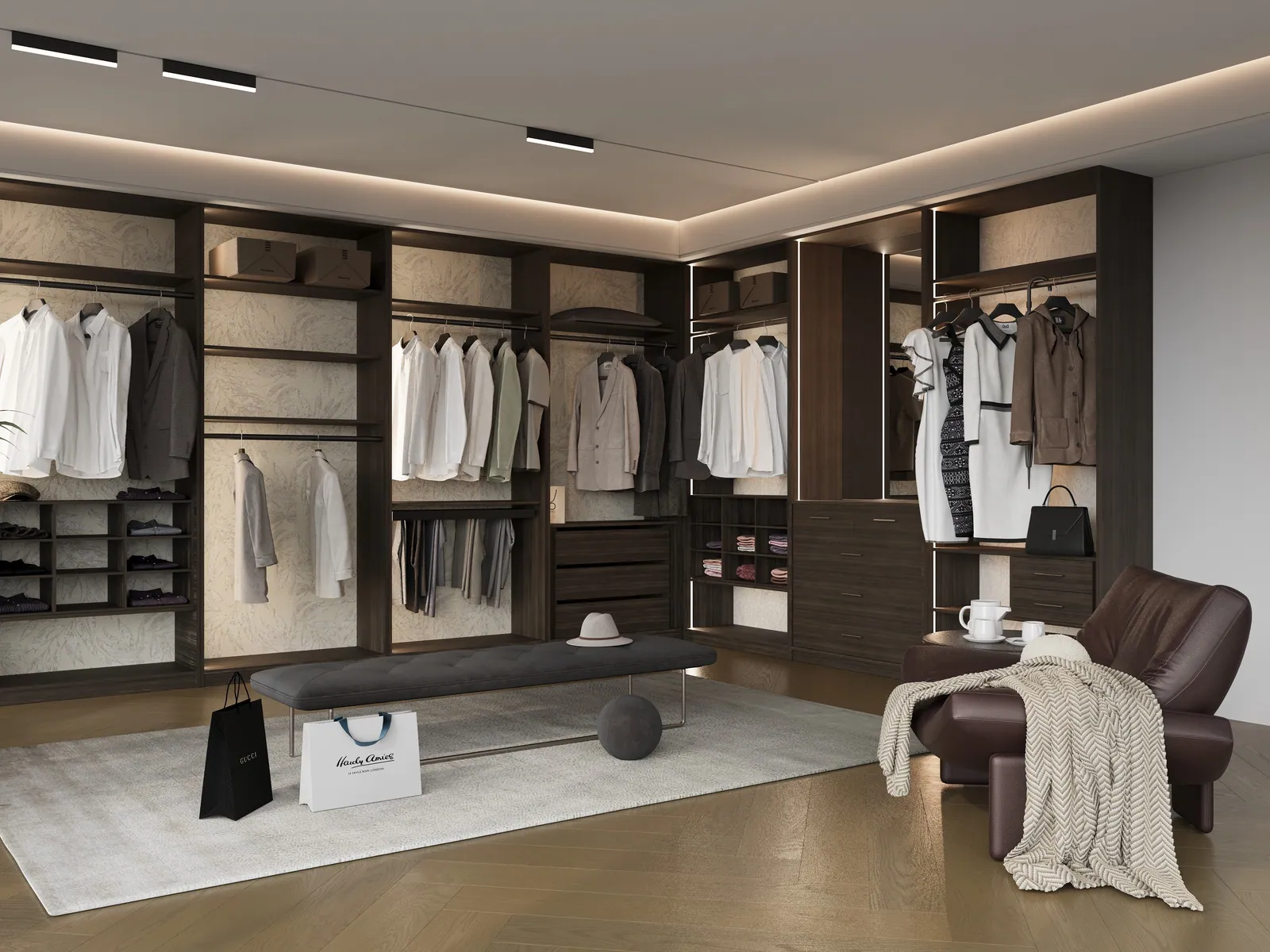
Hanging is composed in three registers. Each exists because a different garment length demands it.
| Register | Rod height (floor to rod) | What it carries |
|---|---|---|
| Double-hang, upper | 80 inches (205 cm) | Shirts, blouses, folded trousers |
| Double-hang, lower | 40 inches (102 cm) | Shirts, blouses, jackets |
| Long-hang | 66–70 inches (168–178 cm) | Dresses, coats, gowns |
| Medium-hang | 54–60 inches (137–152 cm) | Trousers hung full length by the cuff |
Double-hang delivers the highest density per linear foot in the room. Long-hang is routinely over-provisioned: many wardrobes are given far more of it than their actual garment count needs. Medium-hang is the register almost no published chart includes, and it is the correct answer for anyone who hangs trousers by the cuff rather than folded over a bar. The same three registers apply at smaller scale in a reach-in closet, where the cabinet depth stays at 24 inches.
Why Do the Published Numbers Disagree?
Compare the first page of results and the figures do not settle.
According to TaskRabbit and HomeGuide, the standard single-rod height is 66 inches, with the double pair at 80 and 40 inches. Bob Vila puts the lower rod at 40.5 inches, and a widely-shared Pinterest reference gives 38 to 40 inches to centre. Woodweb, a trade forum of working cabinetmakers, gives 40 to 42 inches and 80 to 82 inches for doubles and a 60 to 72 inch range for long hang. An older reference puts a single rod at about 72 inches with the shelf at 84 to 87 inches.
These are not really contradictions. They are different garment assumptions presented as one standard. A 66-inch rod clears a floor-length garment; a 72-inch rod clears a longer one. The spread from 60 to 72 inches is the spread of real coat and dress lengths, and the trade source quotes a range precisely because the trade measures the clothes first.
The practical consequence: a single published number cannot be right for every wardrobe, and treating one as a standard is how a closet ends up with garments dragging the floor or a foot of dead air above them.
What Clearance Sets the Height?
The heights matter less than two clearances.
Vertical clearance for the garment. Allow 36 to 40 inches of hanging space for shirts and 42 to 46 inches for jackets, measured hanger to bar. These are what force the double-hang rods to 40 and 80 inches — stack two shirt-length registers plus the hardware and the upper rod lands where it lands. The height is an output, not an input.
Clearance above the rod. Leave a minimum of 3 inches (8 cm) between a rod and the shelf above it. Below that, hangers scrape on the way in and out — a small daily friction that makes an expensive closet feel cheap.
How Far Off the Wall Does a Closet Rod Go?
Centre the rod 12 inches (30 cm) from the back wall, inside a cabinet 24 inches (61 cm) deep. That places the garment's shoulders clear of both the back panel and the doors.
This is the question the ranking pages skip almost entirely, and it is a frequent cause of rework. A rod set too close to the back wall crushes shoulders against the panel; set too far forward, the doors catch. Twelve inches inside a 24-inch cabinet is the centre of the useful range — and it is why 24 inches is the depth a hanging cabinet wants in the first place.
What Is the Right Height for a 2-Tier or 3-Tier Closet Rod?
A two-tier arrangement is the double-hang described above: rods at roughly 40 and 80 inches, each carrying about 36 to 40 inches of shirt-length hanging.
A three-tier arrangement is usually not three hanging rods. Above roughly 80 inches a rod sits beyond comfortable reach for a majority of adults, so the third register is almost always shelving — a shelf at the head of the cabinet for seasonal storage, with two hanging rods below. If a plan shows three rods, check what is meant to hang from the uppermost one and how it will be reached.
What Height Works for Children and Accessible Reach?
This is where the published charts stop and a standard begins.
Per the 2010 ADA Standards for Accessible Design, the high unobstructed forward or side reach is 48 inches (1220 mm) maximum and the low reach 15 inches (380 mm) minimum above the finish floor. According to the same standard, where a reach passes over an obstruction deeper than 20 inches (510 mm), the high forward reach drops to 44 inches (1120 mm) maximum, with reach depth capped at 25 inches (635 mm).
Read that against a closet and something useful falls out. A hanging cabinet is 24 inches deep — which exceeds the 20-inch obstructed-reach depth. So the governing high reach for a rod inside a standard-depth closet is 44 inches, not 48. Both the 66-inch long-hang rod and the 80-inch double-hang upper sit far above any accessible reach range. That is acceptable in most homes and decisive in one designed for a wheelchair user or for ageing in place.
The US Access Board, which writes these guidelines, also publishes children's reach ranges — better numbers than the vague "30 to 48 inches" the consumer guides offer. According to that data, high reach is 36 inches for ages 3 to 4, 40 inches for ages 5 to 8, and 44 inches for ages 9 to 12, with low reach at 20, 18 and 16 inches respectively. A child's rod set at the high figure for their age is reachable now; an adjustable rod is what keeps it reachable later.
One honest limitation: the ADA governs public accommodations, not private residences, so nothing here is a legal requirement for a house. It is cited because it is the best-documented reach data available, and a closet designed to it still works when reaching changes.
Measure the Clothes, Not the Chart
Our own process begins by measuring a wardrobe rather than opening a chart, because the chart cannot know the answer. A wardrobe of maxi dresses and a wardrobe of tailoring produce two entirely different rooms from the same square footage — different register mix, different rod heights, different shelf positions.
Count the long garments. Count the shirts. Allocate the registers to those counts, then set the heights from the clearances above. That sequence produces a closet where every rod is the right height because it was derived, not copied — and it is how every one of our architectural storage systems begins.
If the room itself is still unsettled, the walk-in closet dimensions guide covers layouts, aisles and clearances, and the honest cost guide covers what the millwork behind these numbers costs.
Frequently Asked Questions
What is the standard closet rod height?
66 to 70 inches for a single long-hang rod, measured floor to rod. That is the figure most sources publish as "standard," but it is specifically the long-garment height. A double-hang pair sits at roughly 40 and 80 inches, and a medium-hang rod for cuff-hung trousers at 54 to 60 inches. Pick the register first, then the height follows from it.
How high should a double closet rod be?
Roughly 40 inches for the lower rod and 80 inches for the upper. Published figures range from 38 to 42 inches on the lower and 80 to 82 inches on the upper, and that spread is not disagreement so much as rounding. The real driver is allowing 36 to 40 inches of hanging space per register, plus the hardware between them.
How far off the wall should a closet rod be?
12 inches from the back wall, inside a cabinet 24 inches deep. That centres the garment so the shoulders clear both the back panel and the doors. Set the rod closer and shoulders crush against the panel; set it further forward and the doors catch on the hangers. This single dimension causes more rework than the rod height itself.
How much space do you need above a closet rod?
At least 3 inches between the rod and the shelf above it. Below that, hangers scrape the shelf every time a garment comes out — a small daily irritation that undermines an otherwise expensive closet. If the shelf carries folded stacks, allow more, because the stack height eats into the same clearance you just measured.
What is the ideal height for a 3-tier closet rod?
There is usually no third rod. Above about 80 inches a rod passes beyond comfortable reach, so the uppermost register is normally a shelf rather than a rod, with two hanging rods beneath it at roughly 40 and 80 inches. If a plan shows three rods, ask what hangs from the uppermost one and how anyone is expected to reach it.
What height should a closet rod be for a child?
Set it within the child's reach range: about 36 inches for ages 3 to 4, 40 inches for ages 5 to 8, and 44 inches for ages 9 to 12, following the published ADA reach ranges. An adjustable rod is worth more than any single height here, because the correct number changes every few years and a fixed rod is outgrown quickly.
Is a closet rod at 48 inches accessible?
Not inside a standard closet. 48 inches is the maximum unobstructed high reach under the ADA standards, but a closet cabinet is 24 inches deep, which counts as an obstruction deeper than 20 inches — so the governing maximum drops to 44 inches. A rod at 48 inches inside a standard-depth closet therefore sits above the accessible range.
Should a closet rod height change for long dresses?
Yes. Long garments are exactly what the 66 to 70 inch long-hang register exists for, and gowns may want the upper end of it. Measure the longest garment from the hanger hook to the hem, add a few inches of float so nothing touches the floor, and set the rod from that measurement rather than from a published figure.
How high should a rod be in a coat closet?
66 to 70 inches, the same long-hang register. Coats are long garments, and a coat closet is essentially a long-hang closet with heavier contents. The height matters less here than the depth: keep the 24-inch cabinet depth and the 12-inch rod centre so bulky shoulders are not compressed against the back wall.
Does closet rod height depend on ceiling height?
Only indirectly. Rod heights are set by garment length and reach, not by the ceiling, so a taller room does not raise the rods themselves. What extra ceiling height buys is the register above the upper rod — shelving carried to the head of the cabinet for seasonal storage. That is the correct use of a tall room's vertical budget, and it is why full-height millwork outperforms a cabinet that stops short of the ceiling.
Have the measurements — want the room? Vallier has been building architectural storage since 1969. Begin with a private in-home consultation across Newport Beach, Laguna Beach, Irvine and Palm Springs: request a design consultation or call (949) 200-6778.