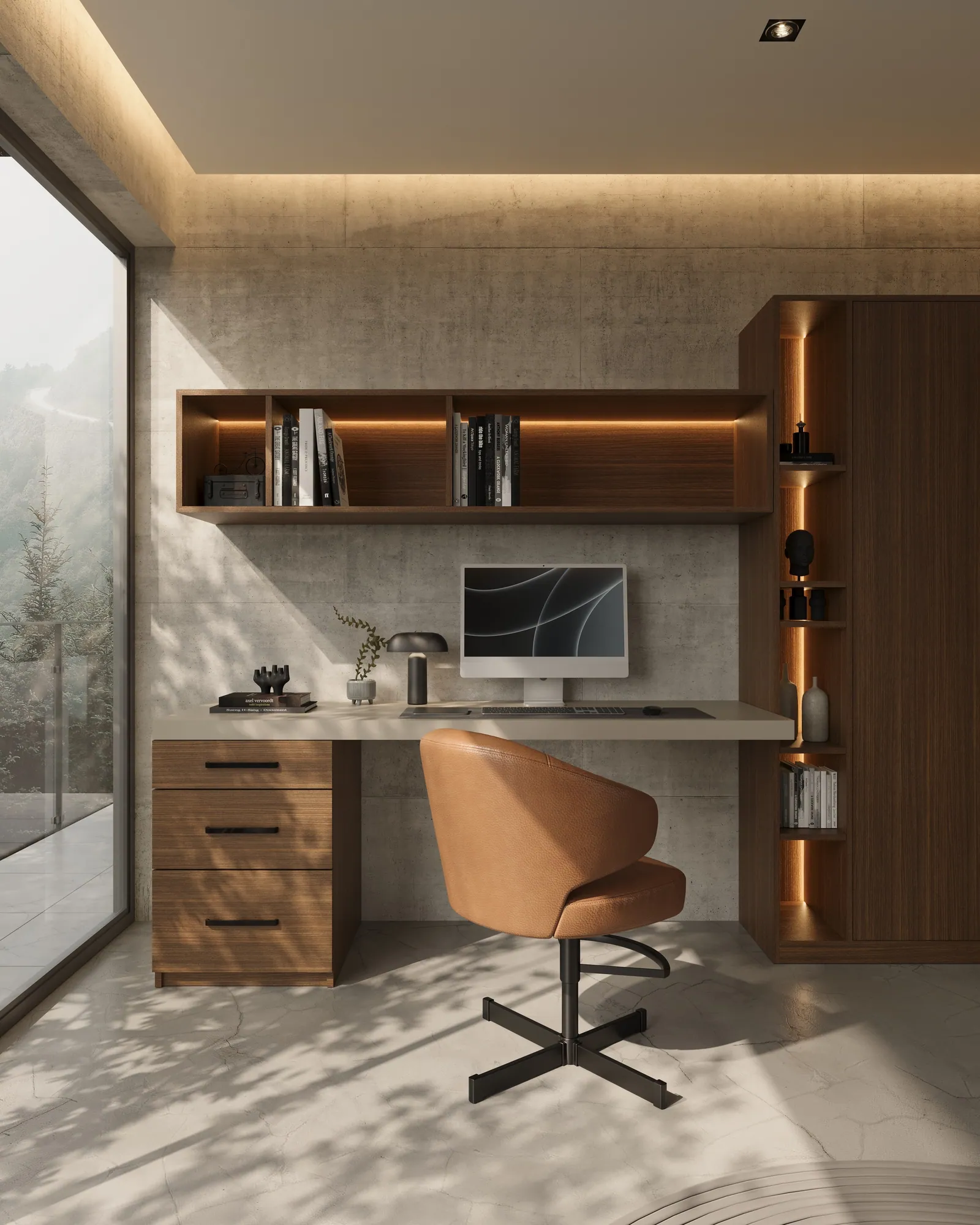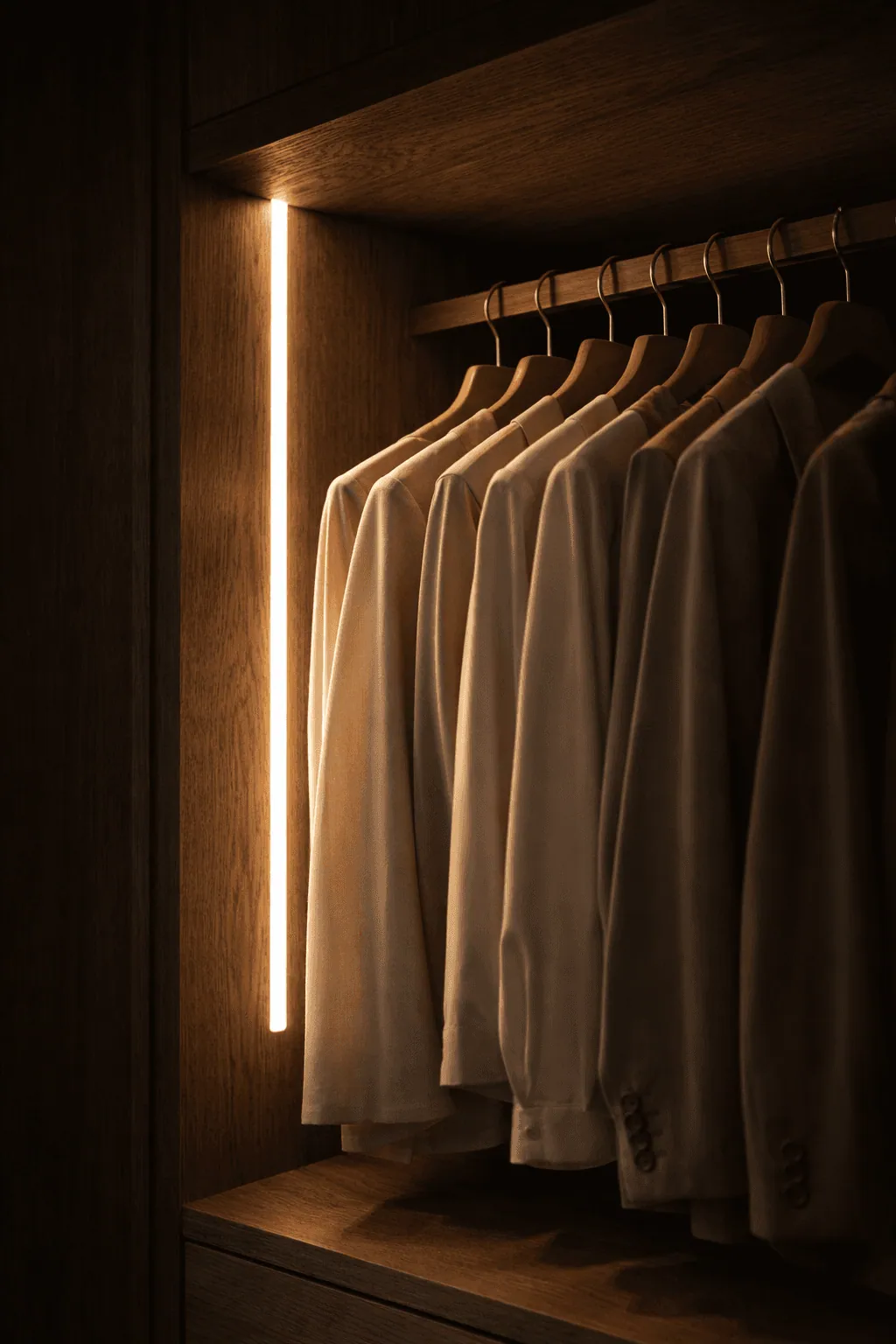
Cinematic interior lighting that highlights the natural texture of European oak.
Nothing exposes an ordinary closet faster than ordinary light. A single fixture on the ceiling flattens the room, throws every shelf into its own shadow, and renders colour so poorly that a navy jacket and a black one become the same object. You dress by memory and hope, and then discover the mismatch in the car. In a room whose entire purpose is to help you see and choose what you own, light is not a finishing touch. It is a primary material, on the same level as the wood.
Vallier treats closet lighting as an architectural system designed alongside the millwork, wired during fabrication, and tuned to the specific wood in the room. This piece explains how that system is built — the vocabulary, the layers, the controls, and the particular reason we favour vertical light raking down a wall of European oak.
Why Closet Light Is a Different Problem
Most rooms are lit for ambience and task. A closet has to be lit for discrimination — the fine visual work of telling charcoal from black, ecru from white, one navy from another, and reading how a fabric will actually look when you step outside. That is a colour-rendering problem first and a brightness problem second.
It is also usually a windowless problem. Interior closets and dressing rooms rarely have meaningful daylight, so the artificial light is not supplementing the sun — it is standing in for it completely. If that substitute light is low quality, there is nothing in the room to correct it. And it is a raking-angle problem: garments hang vertically, so light that falls straight down from the ceiling grazes them uselessly, while light delivered vertically down the face of the hanging illuminates the whole garment evenly.
A Brief History of Bad Closet Light
For decades the standard closet fixture was a single incandescent bulb on a pull chain — warm, low-CRI by modern standards, and hot enough that code eventually restricted how close it could sit to shelving and hanging. The energy-efficiency era replaced it with a compact fluorescent, which was cooler, greenish, slow to reach full brightness, and rendered colour poorly. Both shared the same flaw: one point source on the ceiling, doing every job badly.
Good LED changed what is possible. It runs cool enough to sit inside millwork, it comes in genuinely high colour-rendering grades, it dims smoothly, and it can be delivered as a continuous line rather than a point. That is what makes an integrated, layered, vertical system realistic today in a way it simply was not a generation ago — the technology finally matches what the room always needed.
The Vocabulary Worth Knowing
Colour rendering (CRI / Ra). A 0–100 score for how faithfully a light source shows colour against daylight. Builder-grade LED often sits around 80. For a dressing room the floor is 90, and Vallier specifies 95 or higher, which keeps reds, skin tones, and deep blues accurate. The newer TM-30 metric (Rf for fidelity, Rg for saturation) gives a fuller picture and is used on more demanding commissions.
Colour temperature (Kelvin). How warm or cool the light appears. 2700K is candle-warm; 3000K is soft white; 3500K is neutral; 4000K reads like cool morning daylight. Warm light flatters oak and skin; cooler light matches the daylight most people actually dress for. The resolution is often a tunable-white system that moves between about 2700K and 4000K on a control.
Output (lumens) and delivery. Raw lumens matter less than where they land. A modest, well-placed vertical strip beside a hanging section does more real work than a bright ceiling fixture, because the light reaches the garment instead of the floor.
| Kelvin | Appearance | Effect on oak & garments | Best used for |
|---|---|---|---|
| 2700K | Warm, candle-like | Deepens oak to a golden tone; very flattering to skin; slightly warms whites | Ambient and accent light; evening-dressing rooms; islands and open display |
| 3000K | Soft white | Keeps oak warm but true; a balanced, forgiving default | The most common single-temperature choice for a full closet |
| 3500K | Neutral | Oak reads natural; colour separation improves noticeably | Task light at the mirror and inside deep hanging |
| 4000K | Cool daylight | Most accurate colour matching; can look clinical if used everywhere | The mirror zone only, or the daylight end of a tunable system |
| 2700–4000K tunable | Adjustable | Warm for the room, cool on demand for dressing and colour checks | The preferred solution on higher-specification commissions |
Three Layers of Light
A properly lit closet has three layers doing distinct jobs. Ambient fills the room so it never feels like a cave — usually a perimeter cove, a backlit ceiling reveal, or an even wash. Task light is aimed at where you actually do things: down the face of the hanging, along the front edge of every shelf, at the mirror, into the island drawers. Accent light is the small theatrical layer — a lit niche for a watch box or a handbag, a glow behind an open display section — that gives the room depth after dark.
The mistake in most closets is trying to make one layer do all three jobs. A single ceiling fixture is ambient light pretending to be task light, and it fails at both. Layering costs more circuits and more planning, and it is the difference between a room that is merely bright and a room you can see in.
Where the three layers sit in a closet elevation
Why Vertical, Specifically
A garment on a rail is a vertical plane a metre or more tall. Light from above reaches the shoulders of the top item and nothing else. A vertical LED element mounted at the front edge of the hanging bay — in the gable beside the clothes, or recessed into the vertical divider — runs light down that entire plane at a grazing angle. Every hanging item is lit top to hem, colours read correctly, and you can find the one jacket you want without pulling six others into the room.
The same vertical light does something for the architecture. Raked down a wall of oak with an open-pore finish, it catches every ridge of the grain and gives the panel real depth and movement — the quality people describe as cinematic. A flat frontal light erases that texture; a raking vertical light is what makes the wood look like wood. This is why the lighting and the finish are chosen at the same table: the finish described in our joinery notes is specified partly for how it will behave under this light.
Shelves, Drawers, and the Mirror
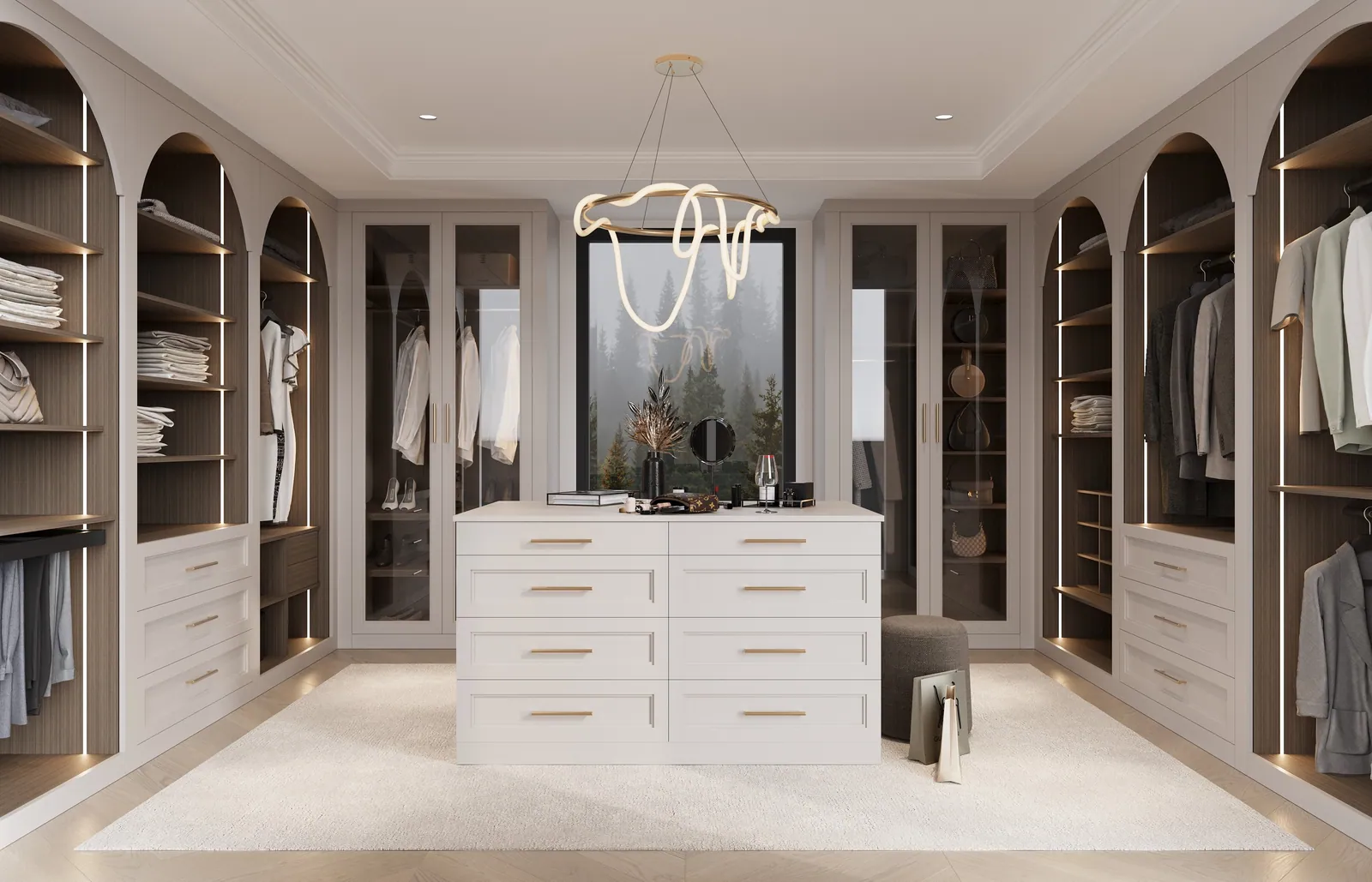
Shelf-edge lighting — a slim LED channel recessed into the front underside of each shelf — lights the shelf below without glare and turns folded stacks into something you can actually scan. Deep drawers get a low-level LED that comes on with a motion sensor as the drawer opens, so a tray of watches or folded shirts is lit from above the instant you reach it and off again when it closes.
The mirror is its own case. Vertical light on both sides at roughly face height, at the cool end of the range (3500–4000K), renders your outfit and complexion the way daylight will. Downlight alone at a mirror casts shadows under the brow and chin and is the reason hotel-bathroom lighting is a punchline. Getting the mirror right is often the single most appreciated part of the whole system.
Dimming, Scenes, and the Body Clock
Because the layers are separate circuits, they can be dimmed independently and saved as scenes. A bright, cool, full-output scene for dressing in the morning; a low, warm, ambient-only scene for putting things away at night without waking yourself up; an accent-only scene that makes the room a lit display when the door is open. Control is typically ELV or 0–10V dimming for smaller systems, or a DALI / low-voltage bus integrated with the home's control system on larger ones.
Tunable-white systems add a circadian dimension: cooler and brighter early, warmer and dimmer late, either on a schedule or on a single dial. It is a small thing that a windowless room benefits from more than most, because the closet is otherwise giving your body no information about the time of day.
Glare Is the Detail That Ruins Everything
The most common failure in closet lighting is not too little light — it is light you can see the source of. A bare LED strip stuck under a shelf, an exposed puck, a downlight aimed so its hotspot catches your eye at the mirror: each one creates glare, and glare does two things. It makes the room uncomfortable to be in, and it makes your pupils contract, so everything not in the bright spot looks darker than it is. You end up with a room that is both harsh and hard to see in.
The fix is that you should never see the diode, only what it lights. Vallier recesses LED into machined channels with a frosted lens, sets it behind a shadow line at the front of a shelf, or tucks it into the return of a gable so the emitter is shielded from every normal sightline. Beam angles are chosen to wash a surface, not to spotlight it. Done properly, you walk into a well-lit room and cannot immediately point to where the light is coming from — which is exactly right.
Metamerism: Why Two Blacks Betray You
Metamerism is the reason a jacket and trousers that matched perfectly in the store look subtly wrong in daylight. Two materials — different dyes, different fibres — can reflect light identically under one light source and completely differently under another. A low-quality light source with gaps in its spectrum hides those differences; a full-spectrum, high-CRI source reveals them, which is what you want happening in the closet rather than on the street.
This is the practical argument for specifying CRI 95 or higher and, ideally, checking the R9 value — the specific measure of deep-red rendering that cheap LEDs fail and that governs how skin tones and burgundies read. It is also the argument for a tunable system: checking a navy-on-black combination at 4000K, close to daylight, tells you the truth before you leave the house. A closet that renders colour honestly is doing the one job a mirror alone cannot.
The Lighting Plan, Room by Room
The layers stay the same; their emphasis shifts with the room. In a reach-in, there is no ceiling to work with, so nearly everything is vertical strips at the front of each bay plus shelf-edge lines, with a single warm wash to keep the box from feeling like a cupboard — the approach in compact, cinematic storage. In a walk-in, a perimeter cove or backlit ceiling reveal carries the ambient layer, freeing the vertical and shelf lighting to be purely task.
An island gets its own treatment: soft downlight or a discreet pendant for the top surface, plus motion-triggered LED inside every drawer so jewellery and watches are lit the instant they open. A dedicated dressing area is built around the mirror — vertical sources both sides at face height, cooler temperature, high output — because that is where the real colour decisions are made. On a whole-home commission these plans are coordinated so scenes behave consistently from room to room, the same way the millwork detailing is carried through.
Buying the Light Once
Not all LED tape is equal, and the differences do not show up on day one. Binning is the sorting of diodes by colour output during manufacture; tightly binned product (a small MacAdam ellipse) means every metre of strip in the room is genuinely the same white, while loosely binned product drifts visibly from bay to bay. Vallier specifies tightly binned tape from named manufacturers with a real warranty — typically three to five years on the tape and longer on the drivers — and keeps a documented record of exactly which product and colour temperature was used.
That record matters because it makes the system repairable years later without re-lighting the whole room. A spare reel of the same bin is often left with the client. It is an unglamorous detail, but it is the difference between a lighting system that is a permanent part of the architecture and one that becomes a mismatched patchwork the first time a section is replaced.
California Code, Heat, and Drivers
California's Title 24 energy code shapes residential lighting: built-in fixtures generally must be high-efficacy LED, JA8-certified where applicable, and paired with the required controls such as dimmers or vacancy sensors. A properly designed integrated-LED closet meets this comfortably — LED at 95+ CRI is efficient by nature — but the compliance is planned in, not discovered at inspection.
Heat and drivers are the practical details that separate an integrated system from a strip-light retrofit. LED tape produces modest heat that still has to go somewhere, so channels are aluminium and act as heat sinks, and the low-voltage drivers are remote-mounted in a ventilated, accessible location — never buried in a sealed cabinet where they will cook and fail early. Good driver placement is also what makes them serviceable in ten years without dismantling the millwork.
A Note on Warm Dimming
There is a subtlety worth specifying on higher-end commissions. A traditional incandescent bulb shifts warmer as it dims — the light turns amber and candlelit at low levels, which is the quality people associate with a relaxed evening room. A basic LED does the opposite or nothing: dim it and you simply get a fainter version of the same daytime white, which can feel cold at low output.
Warm-dim (sometimes called dim-to-warm) LED and its driver are engineered to mimic the incandescent curve, sliding from around 3000K at full output down toward 2200K as they dim. In a closet or dressing room that shares a wall or a sightline with a bedroom, this is often worth the small premium: the bright, accurate morning light and the low, warm, wind-down light come from the same fittings on one dial, and the room never feels clinical when it is turned down. It is a different capability from tunable white, which is set deliberately rather than tracking the dimmer, and some systems offer both.
Build It In, Don't Add It On
Every advantage above depends on the lighting being designed with the cabinetry. Channels are routed into the panels before assembly; wiring paths run through the carcase; drivers get a planned home; switch legs and low-voltage runs are coordinated with the electrician before the walls close. A strip light stuck on afterward gives you some of the brightness and none of the integration — visible channels, glare, dark gaps, and a driver box in the corner of a shelf.
A good integrated system also lasts. Quality LED holds roughly 70 percent of its output — the L70 figure — out to about 50,000 hours, which for a closet is a decade or two of daily use before anything needs attention. The design outlives several rounds of the wardrobe it lights.
What Good Light Costs, and Why It Is Worth It
Integrated lighting is not free. It adds channels routed into panels, more circuits, low-voltage drivers, a control system, and design time to lay it all out. On a typical closet it is a meaningful line item rather than a rounding error, and our cost guide is candid about where that money goes.
What you get for it is a room that performs its core function — helping you see and choose what you own — every single day, and that keeps performing it for fifteen or twenty years. Set against a wardrobe of clothing that itself represents a significant investment, lighting that lets you actually see those garments accurately is one of the higher-return decisions in the whole project. It is also nearly impossible to add well later, which makes it a decision to get right during design rather than regret afterward.
The finish and the light are specified together for the same reason: the open-pore oak treatment described in our joinery notes is chosen partly for how it will hold a raking beam, and the beam is aimed partly for how that finish will answer it. Neither decision is fully made without the other on the table.
Frequently Asked Questions
What colour temperature is best for a closet?
3000K is the best single choice for a full room finished in oak — warm but true. If the budget allows, a tunable system running roughly 2700K to 4000K is better still: warm for the room, cool on demand for dressing and colour matching. Keep 4000K to the mirror zone rather than the whole closet.
Why does colour rendering (CRI) matter so much?
Because the room's job is to let you tell similar colours apart and predict how a fabric will look outside. At CRI 80 that is guesswork; at 95+ it is reliable. It is the specification we would compromise on last.
Can integrated lighting be added to an existing closet?
Some elements can be retrofitted, but the fully integrated result — hidden channels, no glare, coordinated drivers and controls — really needs to be designed with the millwork. It is one of the strongest reasons to plan lighting at the same time as the cabinetry rather than after it.
Do the lights need much maintenance?
Very little. Quality LED runs for a decade or two before output drifts, drivers are mounted where they can be reached, and channels are sealed against dust. When a component eventually needs replacing, accessible driver placement means it is a quick job, not a demolition.
Should the closet lights be on a switch or a sensor?
Usually both. A door or occupancy sensor brings the task and ambient layers up automatically when you walk in and off when you leave, which also satisfies California's control requirements. A wall control or app then lets you dim, switch scenes, or hold a low warm setting for late at night. Accent layers are typically kept on a separate manual control.
What is the difference between shelf lighting and vertical lighting?
Shelf-edge lighting sits under the front of each shelf and lights folded stacks on the shelf below. Vertical lighting runs down the side of a hanging bay and lights hanging garments along their whole length. A complete closet needs both — they solve different problems and neither substitutes for the other.
Planning a closet where the light does justice to the room? Begin with a private in-home consultation across Newport Beach, Laguna Beach, Irvine, and Palm Springs. Request a design consultation or call (949) 200-6778.