Most closet organization fails within a year because it was never architecture to begin with. On zoning, maintenance, and the design decisions that keep a closet ordered without effort.
Every January, the same promise repeats across every household: this is the year the closet gets organized. Bins arrive, labels get printed, an afternoon disappears into folding and stacking — and within a season, the pile has quietly returned. This is not a failure of discipline. It is a failure of design. A closet that requires organizing was never actually designed; it was assembled, and assembled things drift back toward chaos because nothing in their structure resists it.
The premise of this piece is unfashionable in an industry built on organizing products: the best closet is not organized. It is designed so that disorder has nowhere to accumulate. After more than five decades composing storage as architecture, we can tell within a year of installation which closets will still be ordered a decade later — and it has almost nothing to do with how many bins were purchased on delivery day.
Why Organizing Fails and Design Doesn't
Organizing is a verb applied to a static space — you arrive, impose order on what's there, and leave, and the order lasts exactly as long as no new decision needs to be made. Design is different: it removes the decision in advance. A shelf sized precisely to a folded sweater doesn't need a label telling you sweaters go there; a sweater physically doesn't fit anywhere else. A drawer with dividers cut to the width of a rolled tie doesn't rely on willpower to stay tidy; the dividers do the organizing every single time, without being asked.
This is the same argument we made in The Anatomy of a Custom Closet about the difference between a product and architecture. A bin system is a product laid over a room; it depends on you. Millwork designed for a specific wardrobe is architecture; it depends on nothing.
Zoning: The Only Organization System That Works Without You
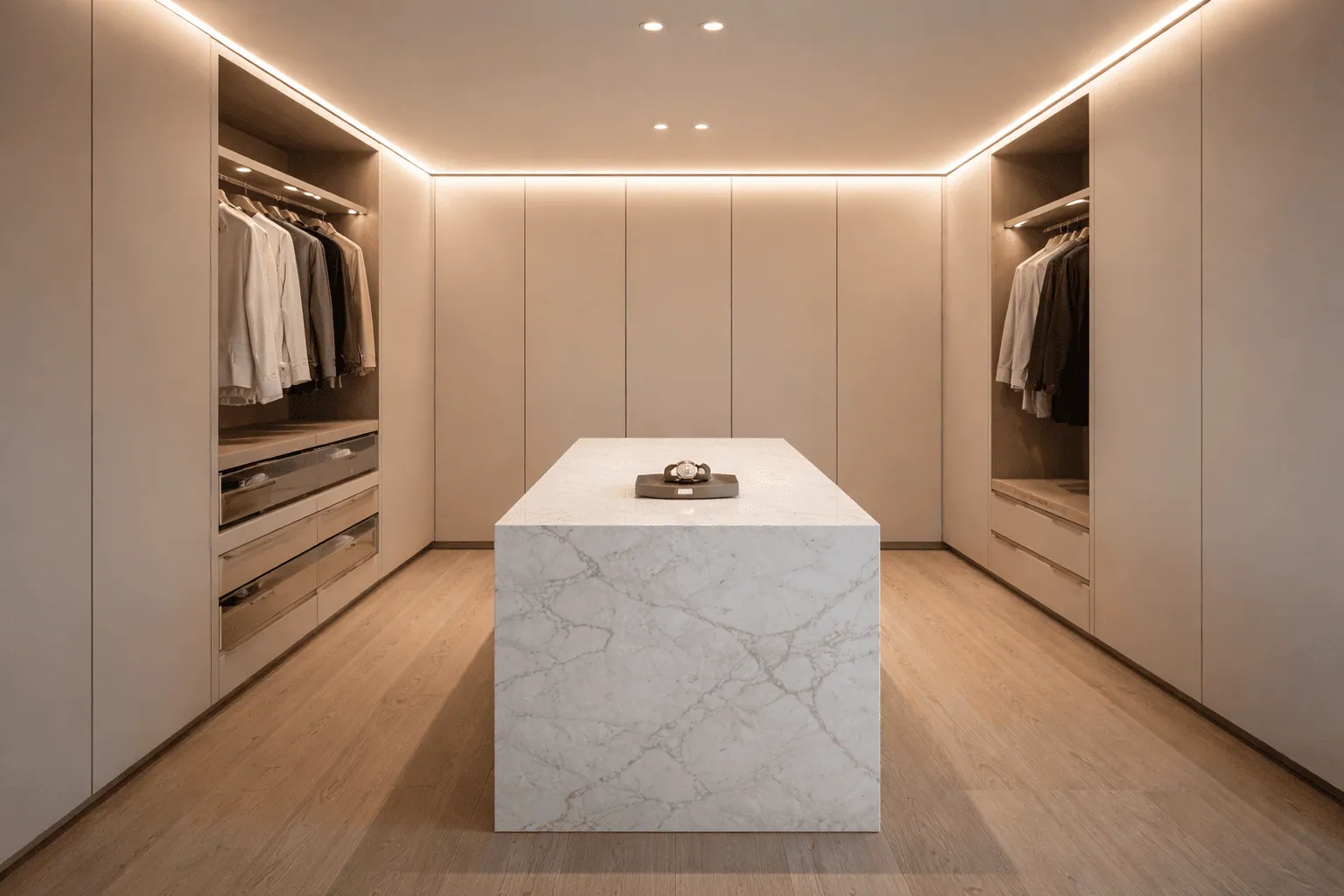
The single design decision that prevents more disorder than any product on the market is zoning by category and frequency, decided before the closet is built rather than negotiated after. Daily rotation — what actually gets worn most weeks — belongs nearest the door, at the easiest reach, on the shortest path from entry to hanger. What is worn occasionally moves further in. What is seasonal moves up or into closed cabinetry entirely. When every category has exactly one honest home, the question "where does this go" stops being asked, because the room already answered it at the design stage.
The details we covered at length in our walk-in closet dimensions guide — hanging heights, shelf depths, drawer allocations — exist for exactly this reason. A shelf cut to the wrong depth invites a second row hidden behind the first, and a hidden second row is where organization always begins to fail first.
Concealment Removes the Need to Look Tidy
Open shelving photographs beautifully and disappoints daily. Every item on an open shelf must be folded to the same standard, faced the same direction, and re-folded the moment it slips — a maintenance job that never ends. Closed cabinetry removes that job entirely: what's inside a drawer can be slightly imperfect and the room still reads as composed, because the room is judged by what's visible, and concealment decides what that is.
This is the same principle we set out in The Principles of Luxury Closet Design: concealment is the highest luxury, and it is also, unglamorously, the lowest-maintenance one. A closet that looks perfect requires effort. A closet that looks perfect because the imperfection is behind a door requires none.
The One-Touch Rule
Most closet disorder originates from friction, not laziness. If putting an item away takes more than one motion — open a door, then a drawer, then move something aside, then place it — the item gets set down on the nearest flat surface instead, and that surface becomes the new pile. We design against friction directly: hooks exactly where a garment is removed, not across the room from it; a hamper within arm's reach of where clothes actually come off; a bench where shoes are removed, positioned beside — not across from — the shoe storage. Every extra motion is a chance for the system to be abandoned, and the fix is architectural, not behavioral: shorten the path until putting things away is the path of least resistance.
Seasonal Rotation, Designed In
Most household closets don't fail from too little space; they fail from every season's wardrobe trying to occupy the daily-access zone simultaneously. A closet designed for rotation solves this permanently: a reserved, easily reached archive register — a top shelf, a closed cabinet bank — sized specifically for the off-season third of the wardrobe, so twice a year the whole system swaps in one clean motion rather than an afternoon of excavation. The rotation becomes a five-minute task instead of a weekend project, because the room was built with the swap already in mind.
Where Organizing Products Still Help
None of this is an argument against organizing products entirely — drawer dividers, velvet hangers, acid-free tissue for delicate storage all genuinely help, provided they are chosen for a space already designed to hold them. The mistake is reversing the order: buying products first and hoping they impose structure on an unplanned room. Products refine a good design. They cannot substitute for one, any more than a label maker can substitute for a shelf that's the right depth in the first place.
The Kids' Closet: Designed to Survive a Child
Nowhere does the design-versus-organizing distinction matter more than in a child's room. No labeling system survives a seven-year-old at 7:40 on a school morning — but a closet where everything has one obvious, low, reachable spot doesn't need to survive anything, because there was never a system to break. Large, simple zones; hooks at a child's height rather than an adult's; bins that are pulled rather than opened. The room organizes itself because a child, with no patience for instructions, can only put things in the one place they obviously belong.
Maintenance: What a Well-Designed Closet Still Asks of You
Even the best-designed room asks something of its owner — just far less, and far less often. A seasonal rotation, twice a year. An honest edit of the wardrobe every year or two, since even a perfectly zoned closet eventually fills with items that no longer earn their place. And the discipline, worth stating plainly, of returning an item to its zone rather than the nearest flat surface — the one behavior no architecture can fully replace, though good design makes it the easiest possible choice available.
If Your Closet Won't Stay Organized, It's Not You
If a closet has been reorganized more than once in the past two years, the room is telling you something the next set of bins won't fix: the zoning is wrong, the depth is wrong, or the daily-access items are simply too far from the door. This is diagnostic information, not a character flaw, and it is exactly the brief we take on in every commission — walking a space, understanding how a household actually gets dressed, and designing a room that holds that behavior rather than fighting it.
How a Redesign Begins
The process starts the way every Vallier commission does: a private in-home consultation, an honest look at the wardrobe as it actually exists rather than an idealized version of it, and a design built around the household's real rhythm. Full-height millwork, zoned by frequency, concealed where concealment serves the room, engineered for the seasonal swap — composed, not organized. Our portfolio is the record of rooms built this way; they have not needed a January resolution since the day they were installed.
Frequently Asked Questions
Why does my closet get messy again so quickly after I organize it?
Because organizing imposes order on a room that wasn't designed to hold it. If categories don't have one obvious, easy-to-reach home, the system depends entirely on daily discipline — and daily discipline is the first thing to lapse. Redesigning the zoning fixes the root cause; reorganizing again only delays the same result.
What is the best way to organize a closet long-term?
Zone by actual frequency of use before buying a single bin: daily rotation nearest the door, occasional wear further in, seasonal items in a dedicated archive register. Concealment for anything that can't be kept perfectly tidy, and a reserved zone for the twice-yearly seasonal swap.
Do closet organizing systems from stores actually work?
They work best as a refinement of a room already well-zoned — dividers, hangers, and bins genuinely help once the underlying architecture is right. Bought first, hoping to impose structure on an unplanned space, they tend to become one more category of clutter within a year.
How do you keep a child's closet organized?
Simple, large, low zones rather than a detailed labeling system — hooks at a child's height, pull bins instead of lidded ones, one obvious place for each broad category. A child cannot maintain a complex system, so the room should not require one.
Tired of reorganizing the same closet every year? Begin with a private in-home consultation across Newport Beach, Laguna Beach, Irvine, and Palm Springs. Request a design consultation or call (949) 200-6778.